
Understanding Decision Making in Healthcare
Decision making in healthcare is a critical process that directly impacts patient outcomes, resource allocation, and overall efficiency of care delivery. Healthcare professionals are often faced with numerous complex situations, requiring them to analyze vast amounts of information and consider various factors before making decisions. These factors include the patient’s medical history, current symptoms, available treatment options, and potential risks. As such, effective decision making is essential not only for the well-being of individual patients but also for the functioning of healthcare systems as a whole.
However, the intricacies and uncertainties associated with healthcare decision making pose significant challenges. For instance, the evolving nature of medical knowledge demands that healthcare providers stay current with emerging research and treatment modalities. Additionally, the variability in patient responses to treatments adds another layer of complexity, as providers must consider both statistical outcomes and individualized patient characteristics. Moreover, the pressure to make timely decisions, especially in emergency scenarios, can lead to increased stress for healthcare professionals.
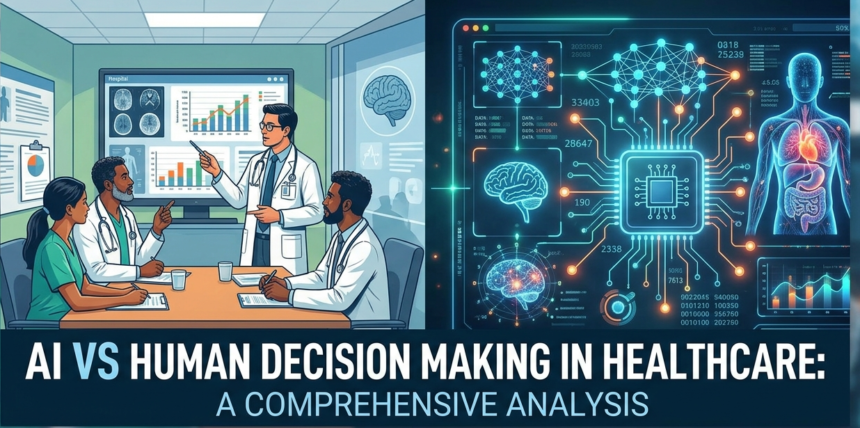
The landscape of decision making in healthcare is also being transformed by advancements in technology, particularly with the introduction of artificial intelligence (AI). AI has proven to be a valuable tool in assisting healthcare professionals by analyzing data quickly and providing evidence-based recommendations. These systems can process and interpret vast datasets far beyond human capability, potentially aiding in the diagnosis and treatment planning processes.
Recognizing the interplay between human judgment and AI capabilities is crucial. While AI can enhance the decision-making process by offering data-driven insights, the intuition, experience, and empathy of healthcare professionals remain irreplaceable. The integration of these two approaches can lead to more informed decision making, combining the strengths of both AI and human intellect to improve patient care.
Understanding Human Decision Making in Healthcare
Human decision making in healthcare is inherently complex, influenced notably by cognitive biases, emotional intelligence, and the extensive experience of healthcare professionals. These factors play a critical role in shaping the choices that practitioners make regarding patient care, treatment options, and resource allocation.
Cognitive biases often impact clinical reasoning, leading healthcare providers to make decisions based on heuristics rather than evidence-based guidelines. For instance, confirmation bias may lead a doctor to favor information that supports an initial diagnosis while dismissing conflicting data. Similarly, availability heuristic might cause a healthcare worker to overestimate the prevalence of conditions they encountered frequently in their recent practice. Awareness of these biases is essential for healthcare professionals as they strive to deliver effective patient care.
Emotional intelligence also significantly influences decision-making processes. Healthcare professionals with high emotional intelligence can better understand and manage their own emotions, as well as empathize with patients. This heightened awareness allows for more compassionate interactions, fostering trust and a deeper understanding of patients’ needs. Furthermore, practitioners often rely on intuition developed through years of experience, which can lead to quicker and often effective decisions in high-pressure situations.
Despite the strengths inherent in human-led decision making—such as empathy, the ability to consider individual patient circumstances, and the nuanced understanding of clinical contexts—there are notable challenges. Emotional fatigue, stress, and time constraints can impair a clinician’s judgment, leading to suboptimal decisions. As healthcare systems become more complex, developing strategies to mitigate these challenges while leveraging the strengths of human decision making will be paramount.
The Role of AI in Healthcare Decision Making
Artificial Intelligence (AI) technologies have made significant strides in healthcare decision making, with applications that span various facets of patient care and operational efficiency. Central to AI’s role are machine learning and data analytics, which enable the processing and analysis of extensive datasets. These capabilities are crucial, especially in environments where large volumes of patient information are generated daily.
Machine learning algorithms can identify patterns within data that may not be immediately visible to human practitioners. For example, they can analyze patient records, genetic information, and treatment outcomes to generate predictive models that assist healthcare providers in making informed decisions. These models can forecast potential health risks, determine the likelihood of disease progression, and even suggest individualized treatment plans tailored to specific patient profiles.
The integration of AI in clinical decision support systems offers additional advantages, including the reduction of human error and the enhancement of diagnostic accuracy. By cross-referencing a patient’s symptoms with a vast database of medical literature and historical patient outcomes, AI can aid clinicians in determining the most effective diagnostic procedures and treatment options. Furthermore, predictive analytics powered by AI can improve patient outcomes by ensuring timely interventions and personalized care strategies.
Moreover, AI contributes to operational efficiencies within healthcare institutions. By optimizing resource allocation, managing patient flow, and predicting service demands, AI tools alleviate some of the administrative burdens that healthcare providers face. This allows healthcare professionals to focus more on patient care rather than routine administrative tasks, leading to improved overall efficiency and patient satisfaction.
In conclusion, the role of AI in healthcare decision making is transformative, enabling more effective and efficient patient care through advanced data analysis and predictive capabilities. As AI technologies continue to evolve, their impact on healthcare will likely expand, prompting ongoing discussions about the interplay between human expertise and machine intelligence.
Advantages of AI Over Human Decision Making
In the rapidly evolving landscape of healthcare, the integration of artificial intelligence (AI) into decision-making processes presents substantial advantages over traditional human-based methods. One of the most prominent benefits of AI is its remarkable speed. AI systems can process and analyze extensive datasets in a fraction of the time it would take a human, enabling quicker diagnoses and treatment plans. This swiftness can be particularly critical in emergency situations, where timely interventions can significantly affect patient outcomes.
Accuracy is another fundamental advantage of AI in healthcare decision making. Advanced algorithms and machine learning models are designed to minimize human error and improve the precision of clinical decisions. By leveraging historical patient data, symptoms, and treatment responses, AI can identify patterns and predict outcomes more reliably than human practitioners who may be subject to cognitive biases or oversight. This enhanced accuracy ensures that patients receive the most appropriate care based on a comprehensive analysis of available information.
Moreover, AI enhances efficiency within healthcare systems. By automating routine tasks such as data collection and initial assessments, AI frees up valuable time for healthcare professionals, allowing them to focus on complex cases that require human empathy and nuanced judgment. The elimination of manual data processing not only speeds up workflows but also significantly reduces operational costs associated with administrative processes.
Another noteworthy advantage of AI is its unparalleled capability to process vast amounts of data without experiencing fatigue or bias. Unlike human decision makers, AI systems continuously learn from new data inputs, effectively diminishing risks associated with burnout and emotional influences. This objectivity is instrumental in promoting equitable healthcare practices across diverse populations.
Limitations of AI in Decision Making
AI technology has emerged as a powerful tool in the healthcare sector, offering significant advancements in diagnostics, treatment recommendations, and patient management. However, there are several limitations that must be addressed before fully integrating AI in decision-making processes. One primary concern is the quality and accuracy of data input into these AI systems. Inadequate or poor-quality data can lead to erroneous conclusions, which in turn could adversely affect patient care.
Another critical limitation of AI is the lack of transparency in how AI algorithms reach their conclusions. Many AI models operate as “black boxes,” meaning that the decision-making process lacks clarity. Healthcare professionals may find it challenging to trust AI recommendations when they cannot understand the reasoning behind them. This opacity may create resistance to adopting AI solutions, especially in clinical settings where informed consent and ethical transparency are paramount.
Moreover, ethical concerns surrounding the use of AI in healthcare are significant. Issues such as bias in algorithms, patient privacy, and accountability arise when AI systems are engaged in decision-making. Bias can originate from the data on which AI systems are trained, leading to disparities in health outcomes among different demographic groups. Furthermore, determining who is responsible when an AI system makes a mistake poses legal and ethical questions that remain largely unanswered.
Finally, AI lacks the capability to grasp the subtle nuances of human interaction and context. The complexities of human health and individual patient circumstances require a profound understanding that AI currently cannot emulate. This limitation undermines the potential of AI to deliver holistic and personalized care experiences.
In summary, while AI has the potential to revolutionize healthcare, its limitations and challenges must be acknowledged and addressed to ensure that it complements rather than replaces human decision-making in clinical environments.
Complementary Roles of AI and Human Decision Makers
In the contemporary landscape of healthcare, the integration of Artificial Intelligence (AI) into decision-making processes is increasingly prevalent. However, a focus solely on AI’s contributions overlooks the significant value that human decision makers provide. Instead, a complementary relationship between AI and humans can enhance patient care and optimize clinical outcomes.
AI systems excel in processing vast amounts of data at remarkable speeds, enabling the analysis of historical and real-time information, which may facilitate diagnostic accuracy and treatment recommendations. For instance, machine learning algorithms can identify patterns in patient data that might be imperceptible to human clinicians. These capabilities can support decision makers by providing evidence-based insights, thus streamlining clinical workflows. However, while AI contributes efficiency, human decision makers bring essential qualities such as empathy, ethical judgment, and contextual understanding to the table.
Human professionals are adept at interpreting and integrating complex information, including nuances that AI may overlook due to its reliance on algorithms. Additionally, they engage with patients on a personal level, fostering trust and understanding, which are critical components of effective healthcare delivery. The ability of human clinicians to consider a patient’s unique circumstances—social, emotional, and psychological—ensures a more holistic approach to treatment. This is particularly relevant in chronic disease management, where continuous patient interaction is fundamental for adherence and stress management.
Moreover, concerns related to AI, such as potential biases in algorithms and data privacy issues, necessitate human oversight to ensure equitable care. By working collaboratively, AI can augment the capabilities of human decision makers while the latter can provide contextual and ethical guidance. In this synergistic relationship, both AI and human expertise merge to optimize decision-making in healthcare settings, ultimately enhancing patient outcomes and promoting a more patient-centered approach.
Case Studies: AI and Human Decision Making in Action
In the evolving landscape of healthcare, numerous case studies have emerged illustrating the interplay between artificial intelligence (AI) and human decision-making. These real-world examples highlight both the potential benefits of such interactions and some notable pitfalls.
One prominent example is the partnership between AI algorithms and radiologists at a leading hospital. In this case, AI was utilized to analyze medical images, particularly X-rays and MRIs, for early signs of diseases such as cancer. The system was trained on thousands of images, enabling it to identify patterns that may be overlooked by the human eye. The radiologists worked in tandem with the AI, reviewing its suggestions and corroborating findings with their clinical expertise. This synergy resulted in vastly improved diagnostic accuracy and a reduction in the time required for image interpretation.
Conversely, a different case study serves as a cautionary tale. An AI system designed to predict patient hospitalizations was deployed in a major healthcare facility. Initially, it provided valuable insights; however, the model relied heavily on specific socioeconomic data that inadvertently led to biased recommendations. Healthcare providers, trusting the AI’s determinations without adequate scrutiny, made flawed decisions regarding patient care. This led to a significant decline in patient trust and highlighted the critical importance of human oversight in AI applications.
In conclusion, these case studies underscore the essential dynamics of AI and human decision-making in healthcare. They illustrate how collaborative efforts can enhance patient outcomes while also revealing the inherent risks when human judgment is sidelined. Ultimately, the best outcomes arise from a balanced approach that leverages AI’s strengths while honoring the invaluable insights of healthcare professionals.
Future Trends in AI and Human Decision Making in Healthcare
The future of decision making in healthcare is set to be significantly influenced by advancements in artificial intelligence (AI) and the evolving integration of human expertise. As healthcare systems worldwide increasingly incorporate AI technologies, several trends are anticipated to shape the landscape of clinical decision making.
One prominent trend is the enhancement of diagnostic accuracy through AI’s abilities to analyze vast amounts of data quickly and efficiently. Machine learning algorithms continue to evolve, allowing for better pattern recognition in medical imaging and patient data. This may lead to quicker diagnosis and treatment plans, highlighting a potential shift in the traditional physician’s role from one of primarily diagnosing, to that of interpreting AI-generated insights.
Moreover, regulatory frameworks surrounding AI applications in healthcare are expected to adapt in response to the rapid technological improvement. Regulatory bodies will likely need to establish guidelines that ensure the ethical and safe deployment of AI systems, addressing challenges such as data privacy, algorithm bias, and the liability of AI-driven decisions. With clear regulations in place, healthcare professionals can feel more assured of the AI tools’ reliability and efficacy.
The role of healthcare professionals will also evolve, as they will need to collaborate more closely with AI systems. This human-AI partnership can lead to personalized patient care, where healthcare providers can utilize AI analytics to better understand patient preferences and medical histories. Furthermore, training programs will need to include education on AI technologies, equipping healthcare professionals with the necessary skill set to work alongside intelligent systems effectively.
In conclusion, the interplay between AI and human decision making in healthcare is poised to transform clinical practices significantly. As innovations continue to unfold, adaptability and collaboration will be essential for healthcare professionals to navigate these advancements successfully.
Conclusion: Finding the Right Balance
Throughout this comprehensive analysis of AI and human decision-making in healthcare, several crucial insights have emerged that highlight the strengths and limitations of both approaches. Artificial Intelligence has the potential to dramatically enhance diagnostic accuracy, streamline operations, and provide data-driven insights. Its ability to analyze vast amounts of medical data is unmatched, allowing for faster identification of patterns that might be overlooked by human practitioners. However, while these technological advancements promise efficiency and improvements in patient care, they should not overshadow the irreplaceable value of human expertise.
Human decision-making is characterized by empathy, ethical considerations, and a deep understanding of the nuances of patient care. Healthcare professionals possess the ability to interpret emotions, communicate effectively with patients, and make complex decisions that take into account individual circumstances and values. These human elements are vital for providing holistic patient-centered care, especially in instances where AI might falter in assessing subjective experiences.
It is evident that neither AI nor human decision-making should operate in isolation. The optimal approach lies in achieving a balance between the two, where AI acts as a supportive tool for healthcare professionals rather than a replacement. By integrating AI into the decision-making process, practitioners can leverage technology to enhance their capabilities while preserving the human touch that patients require. This synergy may lead to improved patient outcomes, as leveraging both AI’s data processing strength and human compassion can create a more comprehensive healthcare environment.
In conclusion, navigating the complexities of healthcare decision-making involves recognizing the complementary roles played by AI and human professionals. Striving for this balance ensures that patients receive the most informed, compassionate care possible, leading to improved outcomes and overall satisfaction in healthcare services.