Understanding Chatbots: What They Are and How They Work
Chatbots are computer programs designed to simulate conversation with human users through text or voice interactions. They serve various functions in business, including but not limited to customer service, lead generation, and as virtual assistants. By leveraging technologies such as natural language processing (NLP) and machine learning, chatbots can understand queries and respond in a way that mimics human conversation.
There are primarily two types of chatbots: rule-based and AI-powered. Rule-based chatbots operate using predefined rules and scripts. They are limited in their functionality and typically utilize a straightforward question-answer format. As a result, they are best suited for handling frequent inquiries or simple tasks. In contrast, AI-powered chatbots are equipped with advanced algorithms that enable them to learn from interactions and improve over time. These chatbots utilize machine learning to analyze user inputs and can provide more nuanced responses, making them ideal for more complex customer interactions.
In various business sectors, chatbots are increasingly utilized for functions such as answering frequently asked questions, helping users navigate websites, and facilitating transactions. For instance, in e-commerce, chatbots can assist customers with product inquiries and order tracking, thereby enhancing the shopping experience. In the sector of customer support, they can manage a large volume of inquiries, providing immediate assistance and freeing up human agents for more complex issues.
Furthermore, the versatility of chatbots allows them to operate across multiple platforms, from websites to social media, ensuring businesses can maintain a consistent presence. This integration fosters improved user engagement and satisfaction while driving operational efficiencies, ultimately contributing to business growth.
Benefits of Chatbots for Business
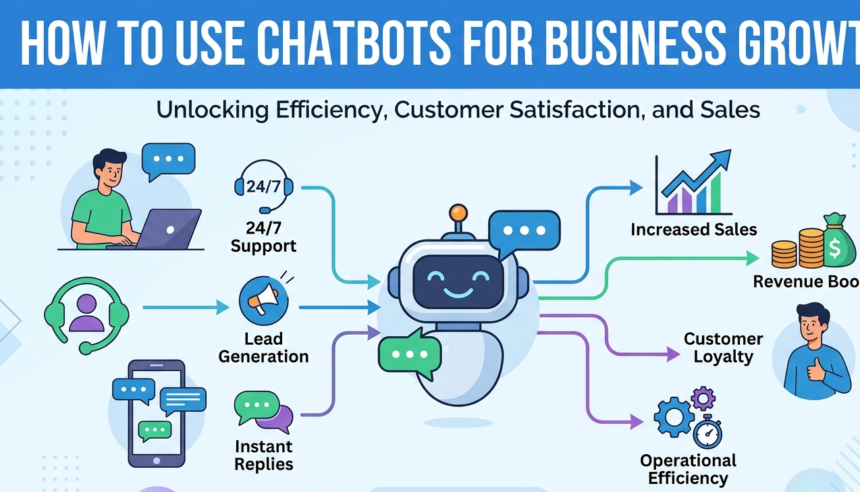
Chatbots have emerged as indispensable tools for fostering business growth. One of the most significant advantages of employing chatbots is their ability to provide 24/7 availability. Unlike traditional customer service methods, chatbots are operational around the clock, ensuring that customer queries are handled promptly, regardless of the hour. This continuous availability not only enhances customer satisfaction but also increases the potential for sales as consumers can interact with services and products at their convenience.
Additionally, chatbots contribute to cost reduction. By automating routine inquiries and processes, businesses can significantly decrease the manpower needed for customer service. This reduction in staff resources allows for a reallocation of funds towards other critical areas, further enhancing productivity. A study by Juniper Research forecasted that chatbots could save businesses over $8 billion annually by 2022, highlighting their financial impact.
Improved customer engagement is another prominent benefit. Chatbots facilitate immediate responses, creating a more interactive and engaging customer experience. By utilizing conversational interfaces, chatbots can guide customers through various stages of interaction, whether it’s providing information, assisting in purchases, or resolving issues. This dynamic engagement can foster brand loyalty, as customers feel more valued when their needs are met quickly and efficiently.
Furthermore, chatbots enable personalized communication. They can analyze user data to tailor interactions based on individual customer preferences and behaviors. This personalized touch not only enhances the customer experience but also drives higher conversion rates. According to a report by Gartner, by 2022, 70% of customer interactions will involve emerging technologies such as chatbots.
Finally, chatbots are excellent for data collection. They can gather valuable customer insights and feedback effortlessly, which can be used to inform business strategies and product improvements. A well-integrated chatbot system can provide businesses with a wealth of information that assists in decision-making and optimizing user experiences.
Identifying the Right Opportunities for Chatbot Integration
In today’s competitive business landscape, it is crucial for companies to optimize their customer service processes and operational workflows to enhance efficiency and customer satisfaction. One effective method to achieve this is by integrating chatbots into relevant areas of the business. First, performing a needs analysis is vital for understanding where chatbot integration can be beneficial. This analysis involves evaluating the current customer service processes, identifying inefficiencies, and recognizing gaps in customer engagement. Conducting surveys, collecting feedback, and using analytics tools can provide valuable insights into how customers interact with your existing systems.
Next, businesses should focus on understanding customer pain points. Identifying common issues faced by customers during their interactions, such as long waiting times or difficulty accessing information, can help pinpoint areas where chatbots can effectively provide assistance. By addressing these pain points, companies can significantly enhance the customer experience. Furthermore, businesses should analyze data to discover frequently asked questions (FAQs) and common service requests; this information can guide the development of chatbot functionalities to ensure they meet customer needs accurately.
Lastly, determining where automation can add the most value is essential for successful chatbot integration. It is advisable to start with tasks that are repetitive and time-consuming, such as scheduling appointments or processing simple inquiries. By automating these tasks, businesses can free up human resources for more complex inquiries that require a personal touch. Overall, a strategic approach to identifying the appropriate opportunities for chatbot integration not only streamlines operations but also cultivates customer loyalty, contributing to long-term business growth.
Choosing the Right Chatbot Platform for Your Business
Selecting an appropriate chatbot platform is a critical endeavor for businesses aiming to leverage automated communication solutions. The first factor to consider is your budget. A variety of pricing models exist, including subscription-based and pay-as-you-go options. Establishing a clear budget will help narrow down choices and avoid overspending on features that may not be necessary for your business’s objectives.
Another important consideration is the technical expertise available within your organization. Some chatbot platforms require substantial technical know-how to implement and maintain, while others offer user-friendly interfaces that can be managed with minimal technical skills. Assessing your team’s capabilities will assist in choosing a platform that aligns with their expertise, thus ensuring effective implementation and long-term management.
User interface and overall user experience also play a crucial role in selecting a chatbot platform. A platform with an intuitive design and easy navigation will facilitate quicker onboarding and reduce the learning curve for your team. Testing multiple platforms to assess their usability can provide insight into which solution is most suitable for your organization.
Scalability is another fundamental factor. As your business grows, the chatbot solution should be able to adapt to increasing demands. Choose a platform that not only meets your current requirements but can also expand functionalities such as handling more inquiries or integrating additional features as your business evolves.
Lastly, consider the integration capabilities with existing tools and systems. A chatbot that seamlessly integrates with your customer relationship management (CRM) software, social media platforms, and any other critical systems will enhance operational efficiency and ensure a cohesive digital ecosystem. Evaluating these factors will enable you to select a chatbot platform that drives significant business growth.
Designing an Effective Chatbot Conversation Flow
Creating an effective chatbot conversation flow is crucial for ensuring that user interactions are both intuitive and engaging. Initially, it is essential to design a structure that reflects user expectations, as an understanding of potential inquiries greatly enhances the chatbot’s capability to provide accurate responses. The process begins by identifying the primary goals of the chatbot, whether it involves customer support, lead generation, or sales assistance. By establishing a clear purpose, developers can better formulate conversation paths.
Next, constructing a comprehensive script is fundamental. This script should incorporate various anticipated user queries and responses, ensuring thorough coverage of topics that users may want to explore. When writing the script, it is vital to employ natural language that aligns with the tone and style of the business brand. Additionally, leveraging synonyms and semantic equivalents helps to replicate a more human-like interaction, fostering better engagement with users.
Another pivotal aspect of designing an effective conversation flow is planning for smooth transitions. This involves establishing points where the chatbot’s responses may lead to confusion or require further clarification. In these instances, it is prudent to enable human intervention, allowing a seamless handoff from the chatbot to a live representative. Such transitions can significantly enhance the user experience, particularly in scenarios where complex inquiries arise. Providing users with options to request human support ensures that they feel valued and heard, underpinning the primary goal of the chatbot.
In summary, a well-designed chatbot conversation flow is integral to business growth. By focusing on user expectations, developing thorough scripts, and facilitating smooth transitions between automated and human responses, businesses can maximize their chatbot’s effectiveness and foster meaningful customer interactions.
Best Practices for Implementing Chatbots
Implementing chatbots in a business setting can significantly enhance customer engagement and operational efficiency. However, to achieve the desired outcomes, it is essential to adhere to several best practices. One of the critical steps in this process is conducting pilot testing. Before a full-scale deployment, businesses should test the chatbot with a small group of users. This not only allows for the identification of potential issues but also provides insights into customer preferences and interaction patterns.
Furthermore, iterating based on user feedback is crucial. Once the pilot is concluded, it is important to collect and analyze feedback from users. This feedback can guide necessary adjustments, ensuring that the chatbot meets customer needs effectively. Continuous improvement based on actual usage can significantly enhance user satisfaction and engagement.
Training staff on how to manage interactions with the chatbot is another important practice. Employees should be well-versed in the chatbot’s capabilities and limitations. They should also know how to intervene when the chatbot is unable to resolve a customer’s issue. This dual approach not only enhances the customer experience but also empowers staff to provide seamless support.
Promoting the chatbot to customers is equally vital. Effective communication strategies should be employed to raise awareness of the chatbot’s existence and capabilities. This might include announcements on the company’s website, social media channels, and through direct marketing approaches. By informing customers about the availability of the chatbot, businesses can encourage its use and drive higher engagement levels.
Lastly, ongoing monitoring and optimization are critical for maintaining the chatbot’s effectiveness. Regularly assessing its performance and user interactions provides insights for further enhancements. Addressing issues promptly and continuously updating the chatbot’s databases ensures that it remains a valuable tool for customer engagement and business growth.
Measuring the Success of Your Chatbot
To effectively gauge the impact of a chatbot on overall business growth, it is imperative to measure its success through relevant key performance indicators (KPIs). These metrics facilitate a precise understanding of the chatbot’s performance and its contributions to customer engagement and satisfaction. One of the primary KPIs is user engagement rates, which provide insights into how actively customers interact with the chatbot. High engagement rates indicate that users find the chatbot relevant and beneficial, which is critical for encouraging user loyalty.
Another vital metric is resolution time, which measures how quickly a chatbot can resolve inquiries or issues. This not only reflects the efficiency of the chatbot but also impacts customer satisfaction. Businesses should strive for a lower resolution time; however, it is equally important to ensure that the resolutions provided are accurate and helpful. Balancing speed and quality is key to maintaining a positive user experience.
Customer satisfaction metrics, often gathered through post-interaction surveys, can help businesses understand how users perceive their chatbot’s performance. Questions might revolve around the helpfulness of the chatbot, the clarity of responses, or overall satisfaction with the interaction. Analyzing this feedback will provide actionable insights for refining the chatbot’s capabilities.
Various tools are available for tracking these KPIs, ranging from built-in analytics in chatbot platforms to third-party business intelligence software. These tools can aggregate data, providing comprehensive reports that help businesses identify trends and areas for improvement. By utilizing these methods for data analysis, organizations can continually iterate and enhance their chatbots, ensuring their alignment with user expectations and business goals.
Overcoming Challenges in Chatbot Implementation
Implementing chatbots can present numerous challenges for businesses, which may deter them from fully harnessing the potential of this technology. One significant obstacle lies in technical limitations. Often, companies lack the necessary infrastructure or expertise to seamlessly integrate chatbots into their existing systems. This can lead to a disjointed user experience, undermining the effectiveness of the chatbot. To overcome this, businesses should thoroughly assess their technological capabilities and invest in training for their staff, ensuring a solid foundation for chatbot deployment.
Another common issue arises from misunderstandings of user intent. Chatbots rely heavily on defined algorithms and machine learning to interpret human inquiries. Instances of miscommunication can frustrate users, as chatbots may provide irrelevant responses. Enhancing the chatbot’s natural language processing capabilities can mitigate this problem. Conducting regular training sessions using real user data will help the chatbot become more proficient in deciphering different types of inquiries.
Resistance from customers and staff can also impede the integration of chatbots. Customers may be reluctant to engage with a non-human interface, fearing it lacks the personal touch they value in customer service interactions. To address this, businesses should focus on promoting the advantages of using chatbots, such as 24/7 availability and quick response times, highlighting their role in enhancing customer experience rather than replacing human interaction.
Employees may also feel threatened by the implementation of chatbots, worrying that these systems could replace their roles. To combat this sentiment, companies should emphasize collaboration between human staff and chatbots, showcasing how these tools can handle routine tasks, leaving employees free to focus on more complex and rewarding activities. Establishing clear communication and providing reassurance will help staff members embrace the change more readily.
Future Trends in Chatbot Technology and Business Applications
The evolution of chatbot technology is set to significantly reshape the landscape of customer interaction and business operations. As artificial intelligence (AI) and machine learning continue to advance, chatbots are becoming increasingly sophisticated, capable of understanding and responding to complex customer queries with remarkable accuracy. This shift is paving the way for chatbots to engage in more meaningful conversations, thereby enhancing customer satisfaction and loyalty.
One of the most exciting trends on the horizon is the rise of voice-enabled chatbots. These applications leverage natural language processing capabilities to enable users to interact via voice commands, creating a more seamless and intuitive user experience. Companies are recognizing the shift toward voice technology, particularly as digital assistants become commonplace in homes and workplaces. This trend will likely lead to broader adoption of voice-enabled interactions in various business sectors, allowing customers to access services hands-free, which can be particularly beneficial in fast-paced environments.
Additionally, the integration of chatbots with augmented reality (AR) and virtual reality (VR) is expected to redefine user engagement. Imagine a customer being able to use a chatbot within a virtual store to get real-time assistance or product recommendations while exploring the digital aisles. Such interactions can enhance not only the shopping experience but also the efficiency of transactions. As AR and VR technologies mature, their convergence with chatbot functionality will create immersive environments for customer service, potentially revolutionizing how businesses connect with their customers.
Ultimately, as these technologies evolve, businesses that leverage the innovations in chatbot functionality will be better positioned to meet their customers’ needs, streamline operations, and drive growth. Embracing these future trends will be essential for companies aiming to maintain competitive in the rapidly changing digital marketplace.