
Introduction to DevOps Automation
DevOps automation is a transformative approach in modern software development, designed to enhance collaboration between development and operations teams. By leveraging tools and processes that automate repetitive tasks, DevOps facilitates a streamlined workflow that is essential for managing large-scale deployments efficiently. The integration of automation within the DevOps framework addresses growing complexities in application development and infrastructure management, which are prevalent in today’s fast-paced technological landscape.
One key benefit of adopting DevOps automation practices is the enhancement of efficiency across all stages of the software development lifecycle. Automated processes reduce the time spent on manual tasks, allowing teams to focus on critical areas such as coding, testing, and deployment. As a result, organizations can achieve a higher rate of production, fostering an iterative development environment that encourages innovation.
Additionally, automation plays a significant role in minimizing errors. By implementing consistent and repeatable processes, teams can significantly reduce the likelihood of human error during deployment. Automated testing and continuous integration practices ensure that errors are detected early in the development cycle, leading to a more reliable final product and reducing the costs associated with post-deployment fixes.
Faster delivery times are another critical advantage of DevOps automation, as it enables teams to release new features and updates more rapidly. This not only meets the demand for swift deployment but also enhances the organization’s ability to respond to customer feedback and market changes. In an environment where consumer expectations continuously evolve, being able to deliver improvements quickly can provide a competitive edge.
In conclusion, DevOps automation is essential for organizations aiming to improve their software delivery processes. By emphasizing efficiency, error reduction, and rapid deployment, companies can better navigate the challenges of large-scale deployments, ultimately driving greater success in their technology initiatives.
Understanding Automation Pipelines
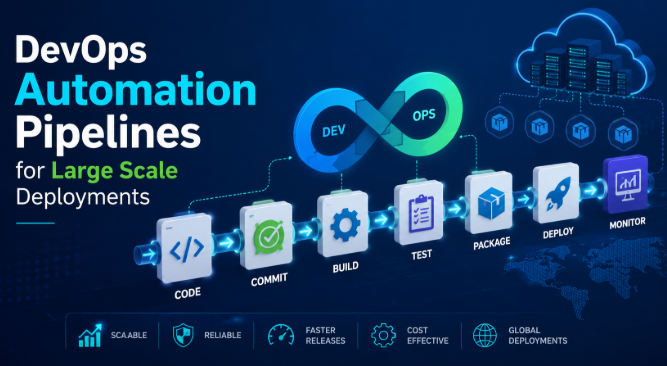
Automation pipelines serve as a fundamental component in the realm of DevOps, significantly enhancing the software delivery process. They are often regarded as a set of automated processes that enable developers and operations teams to build, test, and deploy applications efficiently. The primary objective of an automation pipeline is to minimize manual intervention, reduce the potential for human error, and ultimately accelerate the release cycle.
Key components of automation pipelines include Continuous Integration (CI) and Continuous Deployment (CD) practices. Continuous Integration involves the automatic merging of code changes from multiple contributors into a single codebase, followed by rigorous testing to ensure new code does not disrupt the existing functionality. This aspect of automation pipelines instills a culture of frequent code commits, allowing for easier identification and resolution of integration issues.
Building on this, Continuous Deployment is the next step where code changes that pass all stages of the automated testing process are deployed directly to production. This allows organizations to provide updates and new features to users consistently and reliably, thus improving user satisfaction and engagement. Automation pipelines also incorporate various tools and technologies that facilitate code testing, error detection, and overall monitoring of the deployment process.
In large-scale environments, the effectiveness of automation pipelines is magnified. They enable organizations to handle high volumes of deployments and manage multiple teams efficiently. By streamlining the software delivery pipeline, DevOps teams can focus their efforts on enhancing functionality and addressing user needs, rather than getting bogged down in manual operational tasks. Consequently, automation pipelines emerge as indispensable assets in achieving agile development and deployment practices.
Key Benefits of DevOps Automation for Large Scale Deployments
Implementing DevOps automation pipelines in large-scale deployments offers numerous advantages that can substantially enhance the efficiency and success of software development and operational processes. One of the most significant benefits is the improvement in collaboration between development and operations teams. With automated pipelines, both teams can work cohesively by sharing tools, practices, and goals. This fosters a culture of shared responsibility, where both teams contribute to the end product, reducing silos and promoting communication.
Another critical advantage is the assurance of consistency across various environments, which is crucial for large-scale deployments. Automation pipelines enable standardized processes and configurations, minimizing discrepancies that may occur between development, testing, and production environments. This consistency not only mitigates the risk of errors but also simplifies the deployment process, enabling teams to deploy code faster and with higher confidence.
Moreover, DevOps automation pipelines significantly enhance an organization’s ability to recover from failures. Automated tests and monitoring provide quick feedback and identification of issues, enabling teams to swiftly address and rectify problems before they escalate. This responsiveness is vital, particularly in large-scale environments where downtime can lead to substantial financial losses and damage to customer trust.
Finally, as organizations expand, scalability becomes paramount. Automated deployment processes can effortlessly scale, accommodating increasing workloads and adapting to new technologies without compromising quality. This adaptability ensures that as the organization grows, its deployment capabilities can keep pace, thereby supporting innovation and maintaining competitive advantage.
Challenges in Implementing Automation Pipelines
Implementing automation pipelines in large-scale deployments often presents organizations with several challenges that can complicate the transition process. One prominent issue is resistance to change among team members. Employees accustomed to traditional workflows may be hesitant to adopt new automation tools and practices, leading to a slow adoption rate of the automation pipeline. This cultural shift requires effective change management strategies to address concerns and foster buy-in from all stakeholders involved.
Another significant challenge is the presence of technical debt. Many organizations run legacy systems that may not easily integrate with modern automation solutions. This can pose obstacles in achieving seamless workflows and may require considerable investment in both time and resources to refactor existing infrastructure to support new automation tools. Additionally, as organizations attempt to implement automation pipelines, they may uncover previously unaddressed technical debt, further complicating the process.
Complex infrastructure can also hinder the effectiveness of automation pipelines. Large deployments often involve intricate architectures that can be difficult to navigate and automate thoroughly. It is crucial to fully understand the entire deployment landscape to create automation solutions that address varying system components while ensuring reliability and performance.
Finally, ongoing maintenance and updates to automation scripts are vital yet challenging aspects of sustaining automation pipelines. Regular updates are necessary to accommodate changes in application code, infrastructure, and business requirements. Organizations must allocate adequate resources for monitoring and maintaining automation scripts to ensure that they continue to function optimally and provide the desired improvements in efficiency.
Addressing these challenges requires a strategic approach that emphasizes collaboration between teams, a clear understanding of technological constraints, and a commitment to continuous improvement in automation practices.
Best Practices for Building Effective Automation Pipelines
Creating efficient and reliable automation pipelines is crucial for managing large-scale deployments in any organization. To ensure effectiveness, one of the fundamental best practices includes using version control systems for scripts and configurations involved in the automation process. This allows teams to track changes, collaborate effectively, and revert back to previous versions if necessary, thereby minimizing the risk of deployment failures and enhancing the overall stability of the pipeline.
Incorporating a robust testing framework at every stage of the pipeline is another essential practice. This means that unit tests, integration tests, and end-to-end tests should be executed automatically as part of the deployment process. By doing so, teams can quickly identify and address any potential issues, ensuring that only thoroughly tested code is promoted through the pipeline. Continuous feedback from testing results promotes rapid iteration and improvement, which is vital in a fast-paced development environment.
Moreover, ensuring security within the automation pipeline is non-negotiable. This includes integrating security checks during the build process, using secrets management for sensitive information, and regularly checking for vulnerabilities in dependencies. By adopting these practices, organizations can mitigate the risk of security breaches and maintain compliance with industry standards, all while preserving the velocity of their deployments.
Lastly, cultivating a culture of monitoring and feedback throughout the automation pipeline strengthens its effectiveness. This involves setting up monitoring tools to track performance metrics and anomalies, and fostering a feedback loop among team members to discuss successes and areas for improvement. By actively involving all stakeholders in this process, organizations not only enhance the reliability of their automation pipelines but also promote a proactive approach to problem-solving and innovation.
Tools and Technologies for DevOps Automation
In the realm of DevOps automation, a variety of tools and technologies exist to streamline and enhance the deployment process for large-scale applications. These tools not only facilitate continuous integration and continuous delivery (CI/CD) but also play a pivotal role in ensuring seamless configuration management, container orchestration, and extensive monitoring.
One of the most widely used tools for CI/CD is Jenkins. Jenkins allows developers to automate the building, testing, and deployment of applications, making it a cornerstone in any DevOps automation pipeline. It boasts a wide array of plugins that integrate with various version control systems, testing frameworks, and deployment tools. This flexibility is particularly advantageous for large-scale deployments where different services may require different configurations.
Configuration management tools such as Ansible, Puppet, and Chef are also crucial in maintaining consistency across development and production environments. These tools enable teams to automate the setup of systems and manage server configurations, allowing for scalable and repeatable deployments. Ansible, for instance, uses a simple YAML syntax that is user-friendly, particularly beneficial for teams aiming to swiftly adopt DevOps practices.
Container orchestration technologies like Kubernetes and Docker Swarm enable teams to manage containerized applications at scale. Kubernetes, in particular, offers robust features for scaling, load balancing, and automated rolling updates, which are essential for large deployments. Such orchestration facilitates the deployment and management of microservices architectures, enhancing overall resource usage and deployment speed.
Monitoring tools, such as Prometheus and Grafana, play a vital role in ensuring system reliability and performance in large-scale environments. These tools provide real-time insights and metrics, allowing teams to identify issues proactively and maintain application uptime. By utilizing these monitoring solutions, organizations can efficiently respond to incidents and make informed decisions about infrastructure and application changes.
Case Studies of Successful Large Scale Deployments
Large-scale deployments in contemporary organizations often necessitate the adoption of DevOps automation pipelines. These pipelines streamline processes, enhance collaboration, and reduce the risks associated with deployments. An exemplary case of successful implementation can be observed at Netflix, a pioneer in leveraging automation for deploying updates seamlessly across its platform. Netflix uses a continuous delivery model wherein code changes are automatically tested and deployed, enabling hundreds of deployments daily. This automation minimizes downtime and optimizes performance, significantly improving user satisfaction.
Another pertinent example is that of Walmart, which transformed its operations through the adoption of DevOps practices. Faced with challenges related to managing its massive e-commerce platform, Walmart integrated an automated pipeline for its software development lifecycle. This involved implementing tools like Jenkins and Kubernetes for continuous integration and deployment, which reduced the time needed to roll out new features from weeks to mere hours. Walmart’s transformation showcases how DevOps automation supports rapid innovation while ensuring system reliability.
Furthermore, the case of Target illustrates strategic adaptability in DevOps. After experiencing high-profile failures in their online systems, the company implemented an automation pipeline aimed at improving software quality and system resilience. By incorporating infrastructure as code and automated testing within their pipeline, Target successfully reduced deployment failures and enhanced deployment frequency. This strategic approach not only improved collaboration among teams but also fostered a culture of continuous improvement.
These case studies reflect the imperative role of DevOps automation pipelines in large-scale deployments. The strategic implementation of these pipelines allows organizations to tackle obstacles effectively while reaping substantial benefits, such as improving deployment frequency, enhancing software quality, and increasing team productivity.
Future Trends in DevOps Automation
As organizations continue to embrace digital transformation, the field of DevOps automation is poised for significant evolution. One of the most impactful trends is the increasing integration of artificial intelligence (AI) and machine learning (ML) into development workflows. This incorporation allows teams to automate repetitive tasks, predict system behaviors, and even enhance decision-making processes by analyzing vast datasets. The use of AI in DevOps not only helps streamline deployments but also facilitates better monitoring and incident management, ultimately leading to more robust applications.
Another pivotal innovation gaining traction is the adoption of serverless computing. This paradigm shifts the focus from managing infrastructure to concentrating solely on code. Developers can deploy functions and services in a serverless architecture, resulting in significant cost savings and improved scalability. By eliminating the need for physical servers, organizations can increase their speed of delivery and reduce overhead associated with operations, fostering a more agile development environment.
Moreover, the evolution of Infrastructure as Code (IaC) is transforming how teams provision and manage their IT resources. IaC tools, such as Terraform and Ansible, enable teams to automate their infrastructure setup using code, making it easier to version, replicate, and manage environments. This approach not only enhances consistency across deployments but also minimizes manual errors. With the ongoing advancement of IaC practices, teams can expect improved collaboration and efficiency, as infrastructure management becomes increasingly integrated into the software lifecycle.
In conclusion, the future of DevOps automation is marked by a vibrant interplay of technologies, including AI, serverless architectures, and IaC. As these trends continue to evolve, they are set to reshape not only the DevOps landscape but also the broader scope of software development and operations globally.
Conclusion and Final Thoughts
The advent of DevOps automation pipelines has revolutionized the approach organizations take toward deploying applications at scale. These pipelines serve as crucial enablers of efficiency, flexibility, and reliability across software development and deployment life cycles. The ability to automate processes not only streamlines workflows but also minimizes risks associated with manual interventions. As organizations strive for greater agility, the significance of having robust automation pipelines in place cannot be understated.
Organizations that implement DevOps automation pipelines benefit from reduced deployment times, improved product quality, and enhanced collaboration between development and operations teams. Moreover, the scalability of these pipelines allows businesses to adapt to shifting market demands swiftly, ensuring they remain competitive in an evolving landscape. Automation mitigates human error and promotes consistent delivery, essential components for any enterprise aiming for continuous integration and continuous delivery (CI/CD).
However, simply establishing automation pipelines is not a set-and-forget initiative. Continuous evaluation and adaptation of automation strategies are crucial as technological advancements and business needs change. Companies must invest in the right tools and technologies while fostering a culture that embraces change and innovation. This ongoing commitment to improving automation processes will be vital for enhancing operational efficiency and meeting customer expectations in the fast-paced digital era.
Ultimately, organizations that prioritize the integration of DevOps automation pipelines position themselves as forward-thinking market leaders, ready to harness the full potential of their technology stacks. As the digital landscape continues to evolve, it is imperative that businesses not only adopt but also continuously refine their automation strategies to ensure they remain at the forefront of their industries.