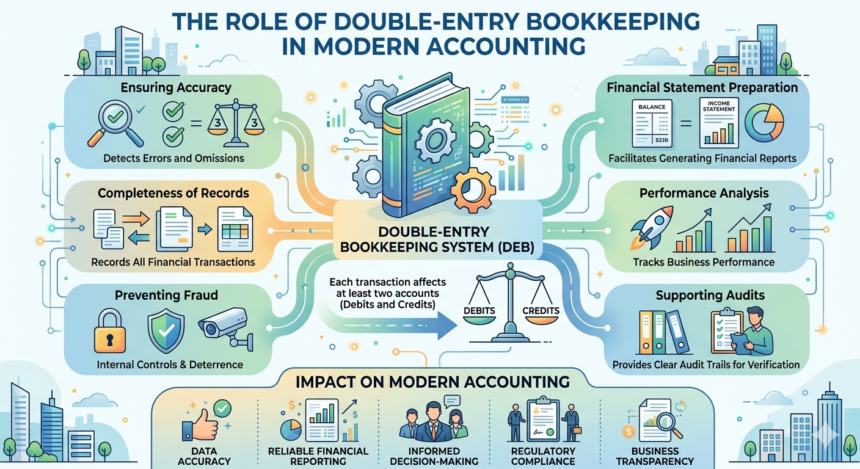
Have you ever wondered how businesses keep financial records accurate while handling thousands of transactions every day? Many professionals begin understanding this system while studying ACA Professional Level, where financial recording methods become clearer and more practical. One concept that sparks curiosity is What is Double Entry Bookkeeping and why it remains central to accounting even today.
Modern organisations depend on reliable records to track income, manage expenses, and review financial performance. Double-entry bookkeeping provides the structure that makes this possible. In this blog, we explore how this accounting method supports modern financial management and why it continues to matter in today’s business environment.
AD
The Growing Importance of Double Entry Bookkeeping in Modern Accounting
Below are the key ways double-entry bookkeeping strengthens modern accounting practices and supports reliable financial management:
Accuracy in Financial Records
The accuracy that double-entry accounting adds to financial records is one of its key advantages. At least two accounts are impacted by each transaction. What enters the business is recorded in one entry, and what leaves is recorded in another.
This approach makes it easier for accountants to find errors. An imbalance in the accounting indicates a problem. Businesses are able to retain more accurate and transparent financial data as a result.
Better Financial Transparency
To gain the trust of stakeholders, modern businesses must be financially transparent. Clear financial records are essential for managers, investors, and regulators to evaluate a company’s success.
Transactions are documented in an organised manner thanks to double-entry accounting. The source and destination of monies are displayed in each entry. Financial reports are simpler to comprehend and validate because of this clarity.
Improved Financial Decision Making
Businesses can make better decisions when they have accurate financial records. When creating budgets and assessing profitability, managers rely on accounting data.
Financial data is organised by double-entry bookkeeping. Decision-makers can rely on reliable and balanced records to direct investments and corporate plans.
Stronger Financial Control
To avoid mistakes and financial mismanagement, financial control is crucial. Systems that assist businesses in tracking transactions and routinely reviewing financial activity are essential.
A transparent audit trail is produced by double-entry bookkeeping. Because each transaction is associated with two accounts, monitoring financial activity is much simpler. Organisational financial control is strengthened by this arrangement.
Reliable Financial Reporting
Well-organised accounting records are essential for financial statements, including income and balance sheets. These reports would be worthless without precise data.
The creation of trustworthy financial reports is aided by double-entry bookkeeping. Financial statements show a comprehensive and balanced picture of corporate activities since each transaction is documented in two locations.
Helps Detect Errors and Irregularities
Any accounting system can make mistakes, particularly when companies deal with a lot of transactions. An organised framework facilitates the prompt identification of these issues by accountants.
Inconsistencies are easy to find because double-entry bookkeeping maintains the balance between debit and credit entries. Accountants are aware that they need to examine the data in order to identify the error when the totals do not match.
Supports Modern Accounting Systems
The logic underlying accounting software still depends on double-entry bookkeeping, despite the fact that many financial tasks are now handled automatically.
The same debit and credit structure is used by digital accounting solutions to record transactions. This demonstrates how, in spite of advancements in technology, the approach still supports contemporary financial management.
Builds a Strong Accounting Foundation
It is crucial for anyone pursuing a career in accounting to comprehend this system. A lot of professional programmes stress how important it is to grasp the fundamentals before going on to more complex subjects.
Delegates can better comprehend how financial transactions move through accounting systems by learning what double-entry bookkeeping is. More sophisticated financial reporting and analysis are built using this knowledge.
Conclusion
Double-entry bookkeeping remains one of the most important foundations of modern accounting. It supports accuracy, transparency, and financial control in organisations of every size. Businesses rely on this system to maintain reliable records and produce meaningful financial reports.
Professionals who want to strengthen their accounting knowledge explore these concepts through structured learning. Training programmes offered by MPES Learning help learners understand practical accounting methods and build confidence in financial management.