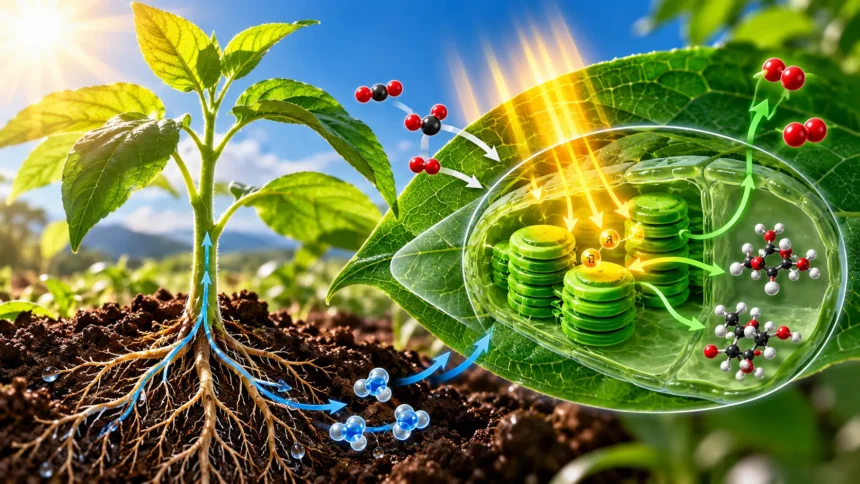
Photosynthesis is one of the most important natural processes on Earth, allowing green plants to produce the food they need to grow and survive. Every day, plants absorb sunlight, water, and carbon dioxide to create energy-rich sugars while releasing oxygen into the atmosphere. This remarkable process supports plant growth, provides food for countless organisms, and helps maintain the balance of Earth’s ecosystems.
Understanding how photosynthesis works in plants step by step can make this essential biological process much easier to understand. From water absorption in the roots to sunlight capture in the leaves, each stage plays an important role in food production. This guide explains the photosynthesis process, its chemical equation, the role of chlorophyll, and the environmental factors that influence how efficiently plants make food.
What Is Photosynthesis and Why Do Plants Need It?
Photosynthesis is the biological process through which plants convert light energy into chemical energy stored in organic molecules. Green plants use sunlight, carbon dioxide, and water to produce sugars that support their growth and development. Oxygen is also released during this process, making photosynthesis important for both plant life and organisms that depend on atmospheric oxygen.
Unlike animals, which obtain food by consuming other organisms, most plants manufacture their own organic nutrients through photosynthesis. These plants are called autotrophs because they use inorganic substances to build energy-rich organic compounds. The sugars produced through photosynthesis provide materials for cellular respiration, growth, reproduction, and the development of different plant structures.
Photosynthesis is also essential for maintaining ecosystems because it provides the foundation for most food chains. Herbivores depend on plants for nutrition, while carnivores indirectly rely on the energy originally captured by photosynthetic organisms. Without this continuous conversion of sunlight into chemical energy, most familiar terrestrial ecosystems would be unable to function.
Where Does Photosynthesis Take Place in Plants?
Photosynthesis mainly occurs in plant leaves because they contain specialized cells with structures called chloroplasts. These tiny organelles contain chlorophyll, the green pigment responsible for absorbing light energy. Although leaves are the primary photosynthetic organs in many plants, green stems and other chlorophyll-containing tissues can also perform photosynthesis under suitable conditions.
Inside each chloroplast are membrane structures called thylakoids, which are often arranged into stacks known as grana. The thylakoid membranes contain pigments and proteins that capture light energy and support the light-dependent reactions. A fluid-filled region called the stroma surrounds these membranes and contains enzymes involved in the Calvin cycle.
Plant leaves are specially adapted to support the photosynthesis process through their structure and arrangement. Their relatively broad surfaces help capture sunlight, while internal air spaces allow carbon dioxide to move toward photosynthetic cells. Tiny openings called stomata regulate gas exchange, helping plants obtain carbon dioxide while managing water loss through transpiration.
Step 1: Plant Roots Absorb Water From the Soil
The first important requirement for photosynthesis is water, which most land plants absorb through their roots. Water enters specialized root cells from the surrounding soil and travels toward the plant’s vascular tissues. Root hairs increase the surface area available for absorption, allowing plants to collect water and dissolved minerals needed for normal biological functions.
After absorption, water moves upward through specialized conducting tissues called xylem. The movement is driven largely by transpiration, which creates tension as water evaporates from leaves. Cohesion between water molecules helps maintain continuous columns of water within the xylem, allowing moisture to travel from roots toward stems and leaves.
Once water reaches photosynthetic cells, some of it becomes available for the light-dependent reactions inside chloroplasts. Water molecules supply electrons that help replace those lost by chlorophyll during light absorption. This process also contributes to oxygen production, demonstrating why an adequate water supply is essential for efficient photosynthesis and healthy plant growth.
Step 2: Leaves Take In Carbon Dioxide From the Air
Carbon dioxide is another essential ingredient plants need to perform photosynthesis because it supplies carbon for building sugars. Plants obtain this gas mainly from the surrounding atmosphere through tiny openings in their leaves called stomata. Carbon dioxide moves inward by diffusion when concentration differences favor its entry, eventually reaching the cells responsible for photosynthesis.
Each stoma is typically surrounded by specialized guard cells that regulate how widely the opening remains open. When conditions are suitable, stomata allow carbon dioxide to enter while oxygen and water vapor can move outward. This exchange is necessary for photosynthesis, but it also creates a challenge because open stomata increase water loss.
During hot or dry conditions, plants may partially close their stomata to conserve moisture. However, reducing stomatal opening can also limit carbon dioxide availability and slow the rate of photosynthesis. Plants must therefore balance carbon dioxide absorption with water conservation, particularly when growing in environments where moisture is limited.
Step 3: Chlorophyll Absorbs Energy From Sunlight
Sunlight provides the energy that drives photosynthesis, making it a fundamental requirement for most photosynthetic plants. Chlorophyll molecules inside chloroplasts absorb certain wavelengths of visible light, particularly in the blue and red regions. Green light is generally absorbed less strongly and is more likely to be reflected or transmitted, which contributes to the familiar green appearance of many leaves.
When chlorophyll absorbs a photon, energy is transferred within a group of pigment molecules toward a specialized reaction center. This energy can excite an electron, allowing the photosynthetic machinery to begin converting light energy into a usable chemical form. Different pigments work together to capture light efficiently and support the reactions necessary for photosynthesis.
Light absorption depends on factors such as sunlight intensity, leaf orientation, and pigment concentration. Leaves exposed to suitable light can capture energy needed for sugar production, while heavily shaded leaves generally receive less usable light. However, extremely intense light can damage photosynthetic systems, so plants have protective mechanisms that help manage excess energy.
Step 4: Light-Dependent Reactions Produce Oxygen and Chemical Energy
After sunlight is absorbed, the light-dependent reactions take place in the thylakoid membranes of chloroplasts. These reactions involve groups of pigments and proteins known as photosystems, which help transfer energized electrons through a series of carriers. Photosystem II begins the process by using light energy to support the extraction of electrons from water molecules.
During water splitting, molecules of water provide electrons and release hydrogen ions and oxygen. The oxygen atoms from water combine to form molecular oxygen, which can eventually leave the plant through its stomata. Meanwhile, electron movement through the photosynthetic transport system helps establish a hydrogen-ion gradient across the thylakoid membrane.
This gradient powers an enzyme called ATP synthase, which produces ATP, an important energy-carrying molecule. Additional light energy absorbed by Photosystem I helps generate NADPH, a molecule that carries high-energy electrons. ATP and NADPH then supply energy and reducing power for the next stage of photosynthesis, where carbon dioxide is incorporated into organic compounds.
Step 5: The Calvin Cycle Converts Carbon Dioxide Into Sugars
The Calvin cycle is the next major stage of photosynthesis and takes place in the stroma of chloroplasts. It uses ATP and NADPH produced during the light-dependent reactions to help convert carbon dioxide into organic molecules. Although the Calvin cycle does not directly require photons, it normally depends on products generated by light-driven processes.
The cycle begins with carbon fixation, when an enzyme called RuBisCO attaches carbon dioxide to an existing five-carbon compound. Through subsequent reactions, the resulting molecules are converted into other carbon-containing compounds using energy from ATP and electrons from NADPH. Some of the products leave the cycle, while the remaining carbon is used to regenerate the starting compound.
One important product of the Calvin cycle is glyceraldehyde-3-phosphate, commonly abbreviated as G3P. Plants can use this three-carbon compound to manufacture glucose, sucrose, starch, and other essential organic substances. Through these reactions, carbon originally present in atmospheric carbon dioxide becomes part of the materials plants need to grow and survive.
Step 6: Plants Use and Store the Sugars They Produce
After producing organic molecules through photosynthesis, plants distribute and use them for several essential biological functions. Some sugars are broken down during cellular respiration to release energy for activities such as nutrient transport, repair, and growth. This process occurs in living plant cells and continues during both daytime and nighttime when suitable resources are available.
Plants also use photosynthetic products to build more complex substances needed for their structures. Glucose-derived compounds contribute to cellulose production, helping form strong plant cell walls in stems, roots, and leaves. Other organic molecules support the development of fruits, flowers, seeds, and new tissues as plants progress through their life cycles.
When plants produce more carbohydrates than they immediately need, some of the excess may be stored as starch. Starch can later be broken down to provide resources during the night or periods of limited sunlight. Sugars such as sucrose also travel through phloem tissues from producing regions to growing or storage areas elsewhere in the plant.
How Is Oxygen Released During Photosynthesis?
Oxygen is a major product of the light-dependent reactions and is released when water molecules are split inside chloroplasts. The oxygen produced can diffuse from photosynthetic cells into internal leaf air spaces. From there, much of it moves through the stomata and enters the surrounding atmosphere when conditions favor outward diffusion.
This oxygen release is one reason photosynthesis has such enormous importance for life on Earth. Humans and many other organisms require oxygen for aerobic cellular respiration, which allows cells to obtain usable energy from food. Photosynthetic organisms help replenish atmospheric oxygen, although Earth’s oxygen cycle also involves respiration, decomposition, and other natural processes.
It is important to understand that plants also consume oxygen during their own cellular respiration. During daylight, healthy photosynthesizing leaves often produce more oxygen through photosynthesis than they use in respiration. At night, when light-dependent photosynthesis stops, plants continue respiring and exchanging gases with their surroundings.
The Chemical Equation of Photosynthesis Explained
Scientists summarize the overall photosynthesis process using a balanced chemical equation that identifies its main reactants and products. The simplified equation shows that carbon dioxide and water, with energy supplied by sunlight, can be converted into glucose and oxygen. It provides a useful overview, although the actual biological process involves many separate enzyme-controlled reactions.
The simplified photosynthesis equation is:
[
6CO_2 + 6H_2O + \text{light energy} \rightarrow C_6H_{12}O_6 + 6O_2
]
In this equation, six carbon dioxide molecules and six water molecules represent the overall inputs used to form one glucose molecule and six oxygen molecules. The equation is balanced because the numbers of carbon, hydrogen, and oxygen atoms match on both sides. Light energy supplies the power needed to drive the overall conversion.
However, plants do not transform carbon dioxide directly into a completed glucose molecule through one simple chemical reaction. Photosynthesis involves light-dependent reactions, carbon fixation, and several metabolic steps before sugars are produced. The oxygen released originates from water rather than carbon dioxide, an important detail that the simplified overall equation does not explicitly illustrate.
What Factors Affect the Rate of Photosynthesis?
Light intensity is an important factor influencing how quickly plants can perform photosynthesis. When light levels are low, increasing available light can improve the rate because more energy reaches the photosynthetic machinery. However, the rate eventually levels off when other factors become limiting, and excessive illumination may cause stress or damage.
Carbon dioxide concentration, temperature, and water availability also influence photosynthesis under different environmental conditions. Increasing carbon dioxide can sometimes raise photosynthetic rates, but only when other resources and biochemical processes permit additional carbon fixation. Temperature affects enzyme activity, while water shortages can cause stomata to close and reduce the amount of carbon dioxide entering leaves.
Different plant species have adaptations that help them perform photosynthesis in their natural environments. For example, certain desert plants use specialized metabolic pathways that reduce water loss during carbon dioxide uptake. Understanding these adaptations helps explain why plants grow differently in forests, grasslands, deserts, agricultural fields, and other ecosystems around the world.
Why Photosynthesis Is Important for Life on Earth
Photosynthesis supports most food chains because it converts sunlight into chemical energy that becomes available to other organisms. Plants, algae, and certain bacteria produce organic compounds through photosynthesis, forming the foundation of many terrestrial and aquatic ecosystems. Animals obtain this stored energy by eating photosynthetic organisms or consuming other organisms that depend on them.
Photosynthesis also plays a major role in the global carbon cycle by removing carbon dioxide from the atmosphere during carbon fixation. Some of that carbon becomes incorporated into living tissues, soils, and other biological materials. However, photosynthetic carbon uptake is balanced partly by respiration, decomposition, and other processes, so its long-term effects depend on ecosystem conditions.
Agriculture depends directly on photosynthesis because crop plants use it to produce the organic materials that eventually become food. Understanding this process helps researchers improve crop management, evaluate plant responses to environmental stress, and develop more efficient growing practices. Photosynthesis therefore connects fundamental plant biology with food security, ecosystems, and the environmental challenges facing modern society.
Conclusion
Photosynthesis is the essential biological process that allows green plants to convert sunlight, water, and carbon dioxide into energy-rich organic compounds. It begins when roots absorb water and leaves take in carbon dioxide, while chlorophyll captures incoming sunlight. Light-dependent reactions produce ATP, NADPH, and oxygen, enabling the Calvin cycle to build carbon-containing molecules used for sugar production.
Each stage of photosynthesis contributes to plant growth, development, and survival. Sugars produced from photosynthetic products support cellular respiration, structural development, and energy storage, while released oxygen contributes to the atmosphere. Environmental factors such as sunlight, temperature, carbon dioxide availability, and water supply determine how efficiently this remarkable process operates.
Understanding how photosynthesis works in plants step by step reveals why it is one of the most important processes in nature. It supports food production, helps regulate the carbon cycle, and provides energy that sustains most ecosystems. From tiny leaves to enormous forests, photosynthesis demonstrates how plants transform the energy of sunlight into the foundations of life.
Frequently Asked Questions (FAQs)
1. What Are the Main Steps of Photosynthesis in Plants?
The main steps include water absorption, carbon dioxide uptake, sunlight capture, light-dependent reactions, and carbon fixation through the Calvin cycle. Plants then use the resulting organic compounds to manufacture and store sugars.
2. Where Does Photosynthesis Take Place in Plants?
Photosynthesis occurs mainly inside chloroplasts found in leaf cells. The light-dependent reactions take place in thylakoid membranes, while the Calvin cycle occurs in the fluid-filled stroma surrounding those membranes.
3. Why Is Sunlight Necessary for Photosynthesis?
Sunlight provides energy that activates the photosynthetic machinery inside chloroplasts. This energy helps produce ATP and NADPH, which support the conversion of carbon dioxide into organic compounds during the Calvin cycle.
4. Do Plants Perform Photosynthesis at Night?
Most plants cannot carry out light-dependent photosynthesis at night because sunlight is unavailable. However, plants continue cellular respiration, and some specialized plants collect carbon dioxide at night for later use.
5. What Are the Main Products of Photosynthesis?
The main outputs include energy-rich organic compounds used to produce sugars and oxygen released from water splitting. Plants use photosynthetic carbon compounds for growth, respiration, storage, and building essential cellular structures.