

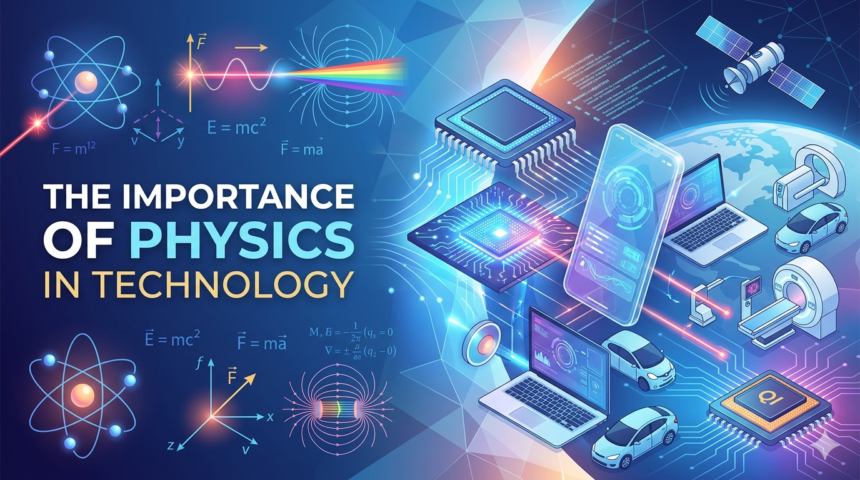
Introduction to the Relationship between Physics and Technology
Physics and technology are intertwined realms of human endeavor, where one informs and enhances the other. Physics, at its core, is the branch of science that explores the fundamental laws governing the behavior of matter and energy. It provides essential insights and principles that underpin various technological advancements and innovations. In this way, physics serves as the theoretical foundation upon which technology is built, facilitating the development of new tools and systems that are crucial to modern life.
The relationship between physics and technology is evident in countless applications, ranging from simple household appliances to advanced space exploration technologies. For instance, the principles of electromagnetism discovered by physicists have led to the creation of electrical devices that power our homes and communicate across vast distances. Similarly, the understanding of thermodynamics has been imperative in developing engines and refrigeration systems that are pivotal in transportation and food preservation.
Moreover, as technology progresses, it not only utilizes the existing findings of physics but also prompts further scientific inquiry. Advancements in technology often raise new questions about the underlying physical laws, leading to innovative research and discoveries. This synergistic relationship fosters an environment where academic inquiry and practical application go hand-in-hand, demonstrating that physics is not merely an abstract discipline but rather an ever-evolving field that continuously shapes technological innovation.
Throughout history, various groundbreaking inventions have emerged from this interplay, illustrating how physics has transformed our technological landscape. From the development of x-ray machines in medicine to the creation of computer systems that process information at lightning speed, the contributions of physics to technology are extensive and profound. As we advance further into the future, understanding this connection will be increasingly vital for addressing global challenges and creating sustainable technological solutions.
Key Concepts in Physics that Drive Technological Innovation
The realm of technology is deeply intertwined with various principles of physics, each contributing fundamentally to advancements across multiple domains. Among these, mechanics, thermodynamics, electromagnetism, and quantum mechanics stand out as central pillars upon which modern technologies are built.
Mechanics, the branch of physics that deals with motion and forces, plays a critical role in engineering and design. From the creation of vehicles to the structure of buildings, the principles of mechanics—such as Newton’s laws of motion—are utilized to predict how objects will behave under various forces. For instance, aerodynamics, a subset of mechanics, is pivotal in the design of aircraft, ensuring efficiency and safety during flight.
Thermodynamics, which concerns heat transfer and the laws governing energy transformation, is essential for a multitude of applications. It governs the principles behind engines, refrigerators, and even power generation in nuclear plants. The laws of thermodynamics dictate how energy can be converted from one form to another, boosting efficiencies and shaping innovations in energy-sustainable technologies.
The concept of electromagnetism intertwines electricity and magnetism, leading to groundbreaking developments in communication technologies and electronics. From simple circuits to complex wireless communications, understanding electromagnetic waves is foundational for the development of devices such as smartphones, radios, and computers. Engineers leverage these principles to enhance connectivity and create more effective electronic systems.
Finally, quantum mechanics opens the door to innovations at the atomic and subatomic levels. It contributes to the development of semiconductors, lasers, and nanotechnology. As researchers continue to unravel the complexities of quantum behavior, new technologies are emerging that promise to revolutionize fields such as computing and medicine.
Historical Perspective: Innovations Rooted in Physics
The journey of technological advancement is deeply intertwined with the principles of physics, reflecting how fundamental scientific discoveries have resulted in transformative inventions. One of the most significant innovations is the electric light bulb, developed in the late 19th century. This invention, attributed to Thomas Edison and Joseph Swan, relied heavily on understanding electrical resistance and the behavior of materials under electric current. The light bulb revolutionized artificial lighting, profoundly changing how people interacted with their environments and extending productive hours into the night.
Another pivotal technological breakthrough is the telephone, invented by Alexander Graham Bell in 1876. The functioning of the telephone is rooted in the principles of acoustics, electricity, and electromagnetism, which play crucial roles in transmitting sound through electrical signals over long distances. This invention redefined communication, connecting individuals across vast geographical distances, thus laying the groundwork for global communication networks.
Nuclear technology is yet another exemplary facet of technological progress driven by physics. The discovery of the atomic nucleus and the understanding of nuclear fission during the early 20th century led to the development of nuclear power and weapons. While the utilization of nuclear energy has been contentious, it undeniably represents a significant leap in harnessing energy and has impacted various domains, from medical applications to national defense.
These examples illustrate that physics not only seeks to understand the natural world but also serves as a cornerstone for technological innovation. The interplay between theoretical physics and practical application underscores the driving force behind many advancements in everyday technology. As we progress further into the 21st century, it is crucial to acknowledge the historical roots of current technologies and recognize the continuance of physics as a powerful catalyst for future innovations.
Physics in Everyday Technologies
Physics plays a pivotal role in shaping the everyday technologies that surround us, influencing everything from household appliances to advanced smartphones and transportation systems. Each of these technologies relies on fundamental principles of physics to enhance functionality and efficiency, thereby improving our daily lives.
Consider household appliances such as refrigerators and washing machines. These devices operate based on the laws of thermodynamics and fluid dynamics, which govern the transfer of heat and the movement of liquids. For instance, refrigerators utilize refrigerants and heat exchange mechanisms driven by the principles of thermodynamics to efficiently remove heat from the interior, ensuring that food remains fresh. Similarly, washing machines incorporate principles of mechanics to optimize the washing and rinsing cycles, leading to effective cleaning while using minimal energy and water.
Smartphones, another ubiquitous technology, are packed with sensors and components that are designed based on physical laws. The functioning of capacitive touch screens, for example, relies on electrostatics, while the transmission of signals in wireless communication hinges upon the principles of electromagnetism. These elements not only enhance user experience but also contribute to the efficiency of data transmission and connectivity in modern smartphones.
Transportation systems are yet another area where physics is crucial. The design of cars, airplanes, and trains incorporates a myriad of physical principles including mechanics, aerodynamics, and fluid dynamics, ensuring safe and efficient travel. The understanding of forces, motion, and energy not only facilitates better engineering designs but also supports advancements in fuel efficiency and emissions reduction, aligning with environmental sustainability goals.
Overall, the integration of physics into everyday technologies underscores the importance of this science in driving innovation and enhancing the functionality of devices we often take for granted. Each encounter with these technologies serves as a reminder of the profound impact physics has on our lives.
Emerging Technologies and the Role of Physics
In recent years, the integration of physics into various fields has played a critical role in the advent and development of emerging technologies such as artificial intelligence (AI), nanotechnology, and renewable energy sources. At the forefront of innovation, these technologies rely heavily on the fundamental principles of physics to enhance their efficiency and functionality.
Artificial Intelligence, for instance, employs algorithms that are grounded in mathematical models derived from physics. Techniques such as machine learning and data processing require an understanding of computational physics, which aids in simulating complex environments. As researchers continue to leverage quantum physics, the prospect of quantum computing emerges, promising to accelerate AI capabilities significantly. This intersection exemplifies how advancements in physical science can lead to breakthroughs in computational technology.
Similarly, nanotechnology has seen remarkable progress facilitated by physical principles. At the nanoscale, materials exhibit unique properties that are not observed in their bulk counterparts. Physicists study these phenomena to develop innovative materials and technologies, such as nanosensors and targeted drug delivery systems. By manipulating substances at an atomic level, they create solutions that can vastly improve medical applications, electronics, and environmental remediation. Thus, the role of physics in advancing nanotechnology cannot be underestimated.
Additionally, renewable energy sources, including solar, wind, and hydroelectric power, are increasingly becoming pivotal in the ongoing transition towards sustainable energy. Physics is essential in optimizing energy capture and conversion processes, such as photovoltaic systems for solar energy. Through the application of thermodynamics and fluid mechanics, breakthroughs continue to enhance the efficiency of energy systems, which is vital for meeting global energy demands while addressing climate change issues.
In conclusion, physics plays an indispensable role in shaping emerging technologies. As the future unfolds, the continuous interplay between physics and cutting-edge fields like AI, nanotechnology, and renewable energy will be pivotal in driving innovations that define our technological landscape.
The Interdisciplinary Nature of Physics and Technology
The relationship between physics and technology is deeply intertwined with several other scientific disciplines, including biology, chemistry, and engineering. This interconnectedness highlights the collaborative nature of scientific exploration, wherein advancements in one area can significantly influence progress in another. For instance, the field of biophysics applies the principles of physics to biological systems, helping researchers understand complex mechanisms such as molecular interactions and protein folding. This interdisciplinary approach not only enhances our comprehension of living organisms but also fosters the development of innovative medical technologies, such as advanced imaging techniques and targeted drug delivery systems.
Similarly, the fusion of physics with chemistry has led to groundbreaking advancements in materials science. By understanding atomic and molecular behavior, scientists and engineers can design and create new materials with desirable properties, such as superconductors and nanomaterials, which have vast applications in various industries. This synergy between physics and chemistry exemplifies how collaborative endeavors can result in technological innovations that push the boundaries of what is possible.
Engineering, another crucial discipline, heavily relies on principles of physics to design and build structures, machines, and systems. The application of concepts such as mechanics, thermodynamics, and electromagnetism are essential in creating efficient and innovative technologies. For example, the development of renewable energy solutions, such as solar panels and wind turbines, is rooted in both physics and engineering. This collaboration not only addresses energy challenges but also promotes sustainable technological advancements.
In summary, the interdisciplinary nature of physics is vital for technological progress. By crossing traditional boundaries and fostering collaboration among physics, biology, chemistry, and engineering, researchers can unlock new potential and drive innovative solutions to contemporary challenges.
Challenges and Future Prospects in Physics-Based Technology
The field of physics, while forming the foundation of modern technology, faces numerous challenges that must be addressed to further enhance technological advancements. One primary limitation is the inherent constraints of current technologies, which can restrict the application of physics principles in real-world scenarios. For instance, advanced materials and devices often suffer from performance limitations due to an inability to manipulate physical properties at the nano-scale effectively. These constraints hinder innovation, particularly in areas such as quantum computing and renewable energy technologies.
Ethical considerations also play a significant role in the evolving landscape of physics-based technology. The rapid pace of technological development raises questions regarding privacy, security, and the societal impact of emerging technologies. As researchers push the boundaries of what is possible, it becomes essential to engage in thoughtful discourse around the responsible application of physics in technology. This includes evaluating the long-term implications of technologies such as artificial intelligence and nanotechnology, which, while beneficial, may pose risks to society if inadequately managed.
Looking to the future, ongoing research in physics promises to deliver innovative solutions to these challenges. Interdisciplinary collaboration among physicists, engineers, and ethicists is crucial for developing technologies that are not only effective but also socially responsible. Future prospects include advancements in quantum technologies, which could significantly enhance computational capabilities and energy efficiency. Moreover, significant progress in understanding complex physical systems may lead to breakthroughs in fields such as climate science and material science, providing sustainable solutions to pressing global challenges. Through dedicated research and ethical consideration, the potential of physics-based technology to improve society is immense.
Educational Implications: Teaching Physics for Technological Literacy
The integration of physics education into school curricula is essential in fostering a society equipped with extensive technological literacy. As technology continues to evolve rapidly, an understanding of the fundamental principles of physics becomes increasingly relevant. By emphasizing the significance of physics in education, we prepare students to engage critically with the technological advancements that shape their lives.
To cultivate a technically literate population, educational institutions must redesign their physics programs to include practical applications of physical concepts. Traditional pedagogies often focus on theoretical aspects, neglecting the real-world implications of physics. However, by incorporating hands-on experiments, interactive simulations, and problem-based learning, educators can enhance students’ engagement and comprehension of complex ideas. This approach not only reinforces core principles but also encourages students to develop innovative solutions to contemporary challenges.
Moreover, the inclusion of interdisciplinary projects that combine physics with subjects such as engineering, computer science, and environmental studies can provide students with a comprehensive understanding of how physics underpins technological systems. For instance, analyzing renewable energy technologies through the lens of physics can empower students to appreciate the role of physics in addressing environmental issues. Such integrative learning experiences can inspire future innovators who possess the scientific acumen to devise new technologies that benefit society.
Ultimately, promoting physics education in tandem with technological literacy is integral to developing critical thinkers capable of adapting to an ever-changing world. By instilling a solid foundation in physics, we equip future generations with the necessary skills to navigate technological landscapes and contribute meaningfully to advancements in various fields. Educational reform that prioritizes the practical applications of physics will pave the way for a more knowledgeable and innovative society.
Conclusion
In this exploration of the integral role of physics in shaping our technological landscape, it becomes evident that the principles of physics form the backbone of many innovations that we often take for granted. From the design of microchips to the science behind wireless communication, physics provides the foundational knowledge necessary for advancing technology. This discipline not only helps us understand how things work but also drives the development of new devices and systems that improve our daily lives.
Moreover, as we have discussed, the interplay between physics and technology is not merely academic; it is a dynamic relationship that continuously fosters growth in numerous fields, including medicine, transportation, and information technology. The advancements we see today are direct results of applying physical principles to solve real-world problems.
Encouraging a deeper appreciation of the physical sciences can inspire future generations to innovate and explore further. Engaging with physics equips individuals with critical thinking skills and a framework for understanding the complexities of our technological world. By fostering a culture that values physics, we can nurture curiosity and encourage exploration in both academic and practical domains.
Ultimately, recognizing the importance of physics in technology helps illuminate the path forward, guiding not only the next wave of technological innovations but also ensuring that we are prepared to face the challenges that lie ahead. As we continue to integrate these two fields, the possibilities for future advancements remain boundless, further underscoring the significance of physics in our ever-evolving technological narrative.