
Have you ever noticed how some businesses respond quickly to problems while others spend too much time working out who is responsible? Many professionals begin exploring this through CIPD Qualification, where business structure and people management are viewed as closely connected.
One area that often draws attention is Divisional Structure, especially in growing organisations that need clearer ownership. When teams, managers, and departments understand their responsibilities, decisions become faster and performance becomes easier to review. This blog looks at how accountability improves when businesses organise work through clear divisions rather than relying on a loose and confusing setup.
Why Accountability Starts with the Right Structure
Accountability is more than just verifying outcomes. It also involves ensuring that accountability is apparent from the outset. A single reporting line or central decision point frequently becomes overburdened in an expanding organisation. Departments rely too much on one another, tasks overlap, and people start shifting problems rather than fixing them. A clear framework lowers that confusion and gives the business a stronger sense of order.
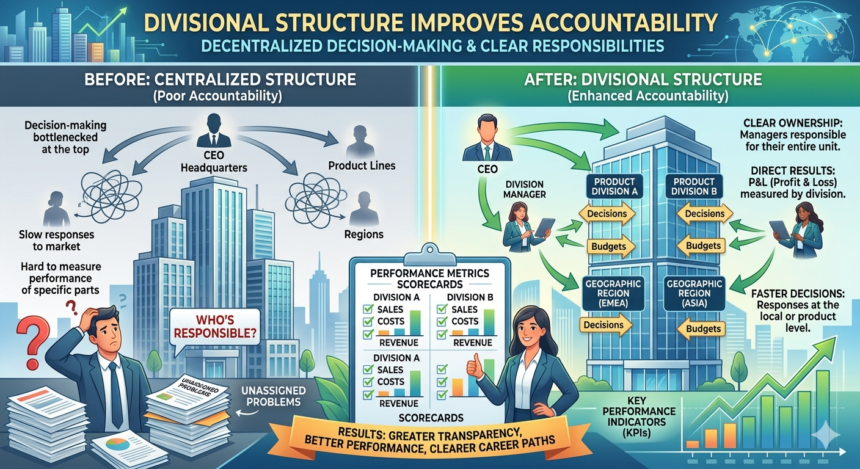
This is supported by a Divisional Structure, which divides the company into discrete divisions, frequently based on market, location, product, or service. Every division has more distinct leadership and goals. This makes it simpler to determine who is responsible for choices, outcomes, and daily performance. The company offers each department its own room to lead and deliver rather than distributing responsibilities too far.
How a Divisional Structure Improves Accountability Throughout the Company
The following points explain how a Divisional Structure improves accountability across the organisation:
Clear leadership within each division
The fact that each division often has a leader or management team is one of the biggest advantages. This establishes a clear point of accountability for that aspect of the company. Strong outcomes make it simpler to identify the people who drove that advancement.
Leaders cannot hide behind broader corporate uncertainty when problems arise. Employees benefit from this as well. They are aware of who they answer to, where decisions are made, and who is supposed to act when something needs to be done.
Better ownership of targets and results
Targets at a company with distinct divisions are frequently closely related to the activities of those divisions. This facilitates the measurement and discussion of performance. Teams are evaluated based on more than just nebulous corporate objectives. They are graded by the results that correspond to their particular area.
It is important to have that sense of ownership. People are more likely to maintain attention and take responsibilities seriously when they can make a clear connection between their labour and results.
Faster and more relevant decisions
Managers are frequently able to make judgments closer to the task itself when they have a divisional structure. Compared to a remote central function, they have a deeper understanding of their teams, clients, and difficulties. Decisions can be made more swiftly and intelligently as a result.
Because decision makers are directly responsible for the results of their decisions, this enhances accountability. They are not merely waiting for permission while transmitting information upstream. They are supposed to take action and then accept the outcome.
Stronger performance monitoring
When a business is organised into distinct parts, performance reviews are significantly simpler. Leaders are able to compare divisions, recognise trends, and pinpoint areas that require assistance. This degree of exposure helps companies in eschewing speculation.
Accountability is easier to uphold when performance is easier to monitor. The output, standards, and advancement of each division can be examined. This lessens the possibility of issues being concealed inside the larger company and fosters more candid discussions about outcomes.
Less confusion over roles and duties
One of the main obstacles to accountability is confusion. Work may be neglected, repeated, or delayed when employees are unclear about their duties. By establishing more distinct boundaries between different areas of labour, a divisional structure lessens this.
Individuals are more likely to understand their manager, their role and the requirements of their job. This makes the operation of company smooth and more simpler to deal with performance in a fair and transparent manner.
Greater focus on local priorities
Often, each division has a distinct function. It might concentrate on a certain product line, geographical area, or clientele. Teams are better able to focus their efforts on the most important demands within their particular division of the company.
Because teams are not pulled in multiple directions at once, accountability is enhanced. They are better able to focus on their priorities, deal with obstacles more skilfully, and accept more accountability for the results they directly affect.
More confidence in internal communication
Simpler and more straightforward reporting lines promote communication. Managers know where to provide updates, employees know where to voice concerns, and divisions may more clearly define their own objectives.
This does not reduce the necessity for wide business communication, but it does increase accountability within each region. It is easier to manage responsibility when people are able to communicate effectively about expectations, progress, and concerns.
Conclusion
A business becomes more accountable when responsibility is clear, visible, and linked to real outcomes. That is where Divisional Structure can make a real difference. It gives leaders, teams, and departments a clearer sense of ownership, while also making performance easier to measure and improve.
Professionals exploring these ideas through the CIPD Qualification often see how strongly structure shapes behaviour at work. For those looking to build a deeper understanding of workplace design and organisational effectiveness, Oakwood International can support that development in a practical and relevant way.