

Introduction to Rocket Science
Rockets are vehicles that harness the principles of propulsion to travel through space and atmospheres, operating on fundamental laws of physics and engineering. Their historical significance began long ago, with early forms of rocketry emerging in ancient China during the first millennium. Initially used for military applications, these prototypes laid the groundwork for the development of modern rockets, transitioning from mere weapons to sophisticated means of exploration.
In contemporary society, rockets serve multiple purposes, including launching satellites, conducting scientific research, and enabling human exploration of outer space. The advent of the space race during the mid-20th century significantly accelerated advancements in rocketry, promoting technological innovations and international collaboration. Notable milestones, such as the launch of Sputnik 1 in 1957 and the Apollo 11 mission in 1969, solidified the role of rockets in expanding human understanding of the universe.
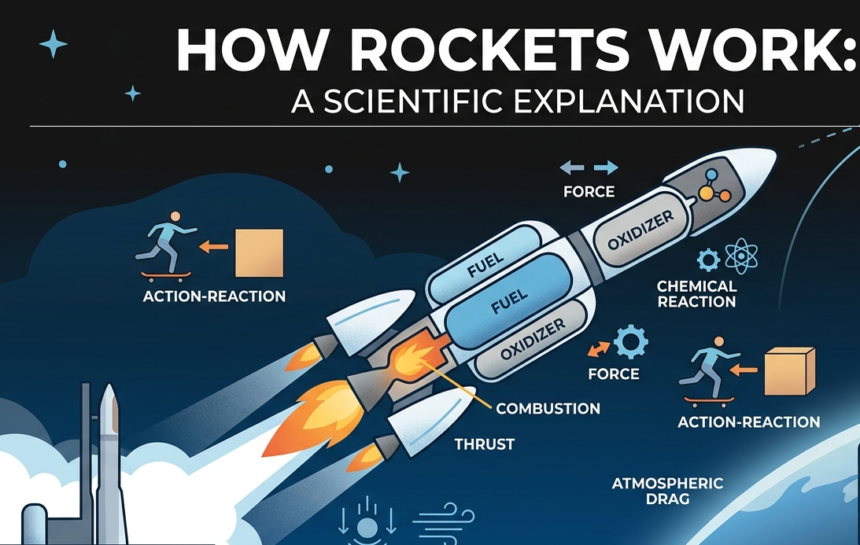
Rockets work on the principle of Newton’s third law of motion, which states that for every action, there is an equal and opposite reaction. When a rocket’s engines burn fuel, they expel exhaust gases downward at high speed, generating thrust that propels the vehicle upwards. This combustion process and the resulting thrust are crucial for overcoming Earth’s gravitational pull and navigating through space. Understanding how rockets function allows us not only to appreciate their intricate design but also to recognize their contributions to modern technology.
As we delve deeper into the science of rocketry, we will explore the various components that constitute a rocket, the technological advancements that have refined their design, and the challenges faced by engineers in this continually evolving field. This journey will ultimately provide a comprehensive insight into how rockets operate and their significant role in shaping our future.
The Physics of Rocket Motion
The movement of rockets can be succinctly explained by fundamental principles of physics, particularly Newton’s Third Law of Motion. This law states that for every action, there is an equal and opposite reaction, providing the essential framework for understanding how rockets achieve lift-off and propel themselves through the atmosphere. Essentially, rockets operate by expelling mass in one direction, which generates thrust in the opposite direction, resulting in motion.
In rocket propulsion, the action occurs when the rocket engine burns propellant, transforming solid or liquid fuel into high-pressure gas. The phenomenon of combustion creates a rapid expansion of gases that are ejected through the nozzle of the engine. As these gases exit at high velocity, they exert a force that pushes the rocket upwards. This mechanism not only illustrates Newton’s Third Law but also highlights the significance of thrust in successful rocket launches.
Moreover, the effective design of rocket engines amplifies the principles of aerodynamics and thermodynamics, ultimately optimizing the thrust produced. Different types of propulsion systems, such as liquid rocket engines and solid rocket boosters, utilize various techniques to maximize the mass flow rate of expelled gas. The efficiency of these systems is crucial, as greater thrust permits rockets to combat gravitational forces and accelerate during their ascent.
In addition to Newton’s Third Law, the concepts of momentum and energy conservation also play critical roles in rocket motion. As a rocket ascends, it not only accelerates due to the thrust generated by the expelled gas but also maintains momentum, allowing continued motion even when propulsion ceases momentarily. Thus, the interplay of these physical laws helps clarify the complex dynamics of rocket motion.
Rocket Propulsion: How It Works
Rocket propulsion is a fascinating field that utilizes the principles of physics to propel spacecraft into orbit and beyond. At the fundamental level, rockets operate on Newton’s Third Law of Motion, which states that for every action, there is an equal and opposite reaction. In simpler terms, as a rocket expels exhaust gases in one direction, it is propelled in the opposite direction. This is achieved through the combustion of propellants—substances that undergo chemical reactions to produce energy.
There are two primary types of propellants used in rocket propulsion: solid and liquid fuels. Solid fuels consist of a mixture of fuel and oxidizer that are combined before use, forming a rigid mass. Upon ignition, combustion produces hot gases which are expelled through a nozzle, generating thrust. Conversely, liquid fuel rockets utilize separate fuel and oxidizer that are stored in tanks and mixed in a combustion chamber just before ignition. This design allows for greater control over thrust levels and engine shutdown, making liquid rockets more versatile for various mission profiles.
The combustion process is critical for both types of rockets, as it converts chemical energy into thermal energy, which leads to the generation of high-pressure gas. The nozzle plays a vital role in this phase. It is designed to expand the hot gases efficiently, converting their thermal energy into kinetic energy as they exit the nozzle. The shape of the nozzle, typically a converging-diverging design, facilitates this transition by accelerating the exhaust gases to supersonic speeds, thereby maximizing thrust.
In summary, rocket propulsion is a complex interplay between propellants, combustion dynamics, and nozzle design. Understanding the differences between solid and liquid fuel rockets, as well as their operational mechanisms, is essential for advancements in space exploration and satellite deployment.
Key Components of a Rocket
A rocket is composed of several key components, each playing a crucial role in its ability to propel into space. The primary elements include the rocket engine, fuel tanks, guidance system, and payload. An understanding of these components is vital for appreciating how rockets function and achieve their objectives.
The rocket engine is arguably the most critical component, as it generates the thrust necessary for lift-off and maneuvering. Rocket engines work on the principle of Newton’s third law of motion, where the expulsion of gas results in an equal and opposite reaction that propels the rocket forward. Common engine types include liquid engines, which burn a combination of fuel and oxidizer, and solid engines, which rely on preloaded propellant.
Fuel tanks are designed to store the propellant that the engine will use. These tanks must be both lightweight and capable of withstanding high pressures, making materials selection an important consideration in their construction. The type of fuel utilized can significantly impact the rocket’s performance, affecting both thrust and efficiency.
The guidance system is essential for controlling the rocket’s trajectory and ensuring it reaches its designated orbit or target. It includes navigational and control systems that monitor the rocket’s position and velocity. These systems use sensors and onboard computers to make real-time adjustments to the rocket’s flight path, enhancing its accuracy and reliability.
Lastly, the payload refers to the cargo carried by the rocket, which can vary from scientific instruments to satellites or even human passengers. The design of the payload area is critical, as it must protect the contents from the extreme conditions of launch and space travel while optimizing the overall rocket design for weight and balance.
The Role of Thrust and Drag
In the intricate dynamics of rocket propulsion, two primary forces are pivotal: thrust and drag. Understanding these forces is essential for evaluating a rocket’s performance during its journey through various atmospheric layers and into outer space.
Thrust is the force that propels the rocket forward, generated by the expulsion of exhaust gases from the rocket’s engines. According to Newton’s Third Law of Motion, for every action, there is an equal and opposite reaction. When combustion occurs, the engine expels hot gases downward at high speed, thereby generating thrust that pushes the rocket upwards. Engineers optimize thrust by carefully designing the rocket engines, which can include variations in fuel composition, nozzle design, and chamber pressure to maximize efficiency and performance.
However, as the rocket ascends, it encounters drag, which is the resistance force opposing the rocket’s forward motion. Drag is influenced by several factors, including the rocket’s shape, size, surface texture, and the atmospheric conditions it encounters. As the rocket travels through the denser layers of the atmosphere, drag can significantly impact its velocity and fuel consumption. Engineers aim to minimize drag through aerodynamic design, ensuring that the rocket’s outline allows for smoother airflow. Additionally, as altitude increases and the atmosphere thins, the effects of drag decrease, allowing for more efficient travel.Moreover, the balance between thrust and drag is crucial; insufficient thrust may hinder the rocket’s ability to overcome drag and thus slow its ascent, while excessive thrust can lead to structural damage or inefficiencies in fuel use.
In summary, the interplay between thrust and drag is vital for the successful trajectory of a rocket. Understanding these forces not only helps in the design and optimization of rocket systems but also enhances the effectiveness of space exploration missions.
Stages of Rocket Launch
The launch of a rocket is a complex process that can be divided into several distinct stages, each critical to the success of the mission. Understanding these stages is crucial for comprehending how rockets work and traverse through the atmosphere into space.
The first stage of a rocket launch begins with ignition. During this phase, the rocket’s engines are ignited, producing thrust necessary for lift-off. The fuel burns rapidly, generating high levels of energy that propel the rocket upwards. This moment is crucial, as it marks the transition from ground conditions to the initiation of flight. The rocket must overcome gravitational forces and atmospheric resistance for a successful ascent.
Once the rocket has lifted off, it enters the ascent phase. During this stage, the vehicle climbs through the Earth’s atmosphere, gradually altering its trajectory to reach the desired orbit. The engines continue to burn fuel, and the rocket accelerates, all while facing air resistance that must be managed effectively. Various systems onboard continuously monitor performance, ensuring optimal conditions for reaching higher altitudes. This phase is often marked by significant gravitational forces acting on the payload and crew, known as G-forces.
After reaching a predefined altitude, the rocket usually undergoes stage separation. This critical moment involves the discarding of empty fuel tanks or rocket stages that are no longer needed for the journey to orbit. By jettisoning these components, the rocket becomes lighter, allowing the remaining stages to accelerate further into space with enhanced efficiency. Stage separation is meticulously timed to maintain momentum and ensure that the rocket can achieve the necessary velocity to enter orbit.
In summary, the stages of a rocket launch—ignition, ascent, and stage separation—each play a fundamental role in the journey from the ground to space. Understanding these components not only sheds light on how rockets function but also illustrates the intricate engineering and physics at work in modern space exploration.
Rocket Science in Space Exploration
Rocket science plays an essential role in enabling and facilitating space exploration missions, acting as the driving force behind humanity’s quest to venture beyond our home planet. The fundamental principles of rocket propulsion and aerodynamics apply as space agencies, such as NASA and ESA, design, build, and launch vehicles to explore celestial bodies.
One of the most iconic missions demonstrating the application of rocketry is NASA’s Apollo program, which successfully landed astronauts on the Moon between 1969 and 1972. The Saturn V rocket, a monumental feat of engineering, was pivotal in this mission. With its powerful multi-stage design, it allowed for efficient lifting of massive payloads beyond Earth’s gravitational pull, showcasing the importance of rocket technology in achieving such ambitious goals.
In addition to lunar missions, rocket science has enabled a multitude of exploratory missions to other planets. NASA’s Mars rovers, such as Spirit and Curiosity, relied on advanced launch vehicles to traverse the 225 million kilometers separating Earth from Mars. These rovers, equipped with cutting-edge scientific instruments, have provided invaluable data regarding the Martian environment, ultimately contributing to our understanding of potential habitability beyond Earth.
Moreover, modern space exploration benefits from numerous technological advancements derived from rocket science. The introduction of reusable rockets, exemplified by SpaceX’s Falcon 9, revolutionizes launch economics and sustainability. Such developments not only enhance mission feasibility but also pave the way for more frequent and cost-effective exploration efforts.
Space exploration continues to evolve, with missions planned for the Moon’s Artemis program and future human exploration of Mars. Rocket science will remain central to these endeavors, enabling humanity to push the boundaries of our knowledge and presence in the universe.
Challenges in Rocket Design and Flight
The design and launch of rockets are fraught with a myriad of challenges that engineers must meticulously navigate. One primary concern is safety. Rockets operate under extreme conditions, with high pressures and temperatures that can lead to catastrophic failures. Ensuring the integrity of both the vehicle and its payload during intense phases of flight is paramount. Engineers conduct extensive testing to identify potential failure points, which can add significant time and cost to the development process.
Cost is another critical factor in rocket design. The aerospace industry often faces budget constraints that limit the materials and technologies that can be employed. Developing advanced propulsion systems, lightweight structural components, and sophisticated guidance and control systems all require substantial financial investment. Moreover, with increasing competition in space exploration, balancing performance with economical design is crucial for companies that seek to remain viable in a rapidly evolving market.
Technological limitations also pose a significant hurdle. While advancements in materials science and propulsion technology have greatly enhanced rockets’ capabilities, many challenges remain unresolved. For instance, the development of environmentally friendly propellants continues to be a focus area, as traditional rocket fuels can have adverse ecological impacts. Engineers are exploring alternative fuel options and innovative designs to minimize the environmental footprint of space launches without compromising performance.
Lastly, environmental considerations are becoming increasingly important in the context of rocket launches. The emissions generated during takeoff can contribute to atmospheric pollution. Addressing these issues not only aligns with global sustainability efforts but can also impact regulatory approvals. Thus, engineers must integrate solutions that ensure rockets are not only efficient and reliable but also responsible in terms of their environmental impact.
The Future of Rocket Propulsion
The field of rocket propulsion is on the brink of transformative advancements that promise to redefine how we explore space. As researchers and engineers strive for greater efficiency and effectiveness, several key developments are emerging on the horizon of rocketry. One significant area of focus is the advancement of propulsion systems, particularly the move toward hybrid and electric propulsion technologies. These systems have the potential to enhance fuel efficiency, reduce environmental impact, and lower costs, making space exploration more accessible than ever before.
Another pivotal advancement expected in rocket technology is the refinement of reusable rocket systems. Companies like SpaceX have already made significant strides in this area, demonstrating that rockets can successfully land and be reused for multiple missions. This paradigm shift not only decreases operational costs but also paves the way for more frequent launches, thus accelerating our pace of exploration and experimentation beyond our planet.
Moreover, the notion of interplanetary travel is no longer confined to science fiction. As technology evolves, the feasibility of manned missions to Mars and beyond appears increasingly achievable. The development of advanced propulsion systems, such as ion thrusters and nuclear thermal rockets, is particularly promising. These systems provide higher thrust-to-weight ratios, allowing spacecraft to travel faster over long distances, which is crucial for interplanetary missions where time is of the essence.
Additionally, the innovation of fuel sources, ranging from methane to solar sails, serves to further enhance the sustainability and practicality of future rockets. As humanity expands its horizons in space exploration, the integration of these technologies will be essential not only for planetary missions but also for deep space exploration endeavors. The future of rocket propulsion holds the potential to inspire generations, fundamentally reshaping our understanding and approach to journeying through the cosmos.