

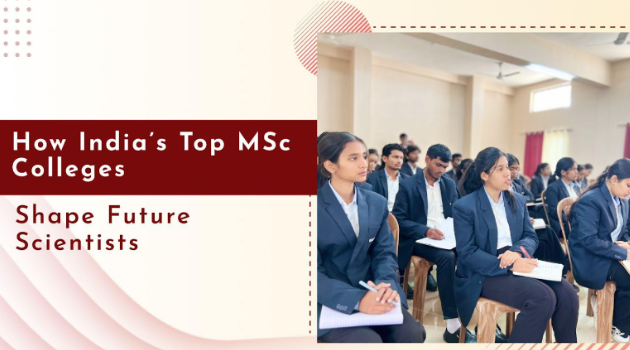
One thing that becomes very clear when you look at how science education in India has changed over the years is that the idea of post-graduate science being just about textbooks and exams is no longer valid. Today’s MSc students demand more. They want labs that resemble real research settings, mentors who challenge them to think, and a system where their inquisitiveness is not curtailed by antiquated structures. The top MSc colleges in India are already responding to this change. They are creating spaces for learning where students can discover, inquire, verify, make errors, and try their course of action again, just like actual scientists do. What this essentially implies is that the criteria for a good MSc program have changed. It is no longer just about the degree. It is about the environment that shapes your thinking and the opportunities that facilitate your growth.
The New Era of MSc Education — What Students Expect Today
The fact is that students of modern science are not content with passive learning. They expect their MSc program to:
- Enable them to have in-depth research
- Familiarize them with scientific instruments and the lab environment
- Promote independent thinking
- Link them with the industry or research institutions
- Ready them for scientific work in the real world
The colleges that are located all over India and are able to become the leaders are those that are willing to accept this change. Their laboratories are not maintained as exhibits but as places where work is carried out. Their teachers are not only involved in instruction but also engage students in research, data analysis, academic writing, and even scientific ethics. Nowadays, students look for three things most of all:
- Learning Environments That Go Beyond Theory: Contemporary MSc programs involve practical parts, simulations, advanced lab work, research papers, and oral presentations. The ultimate objective is to develop scientific habits and build the learners’ confidence.
- Mentors, Not Just Teachers. Support is important: Good colleges establish a system in which faculty members help students recognize their academic strengths and encourage them to take on challenging ideas.
Such a change in expectation is influencing the manner in which leading MSc programs function.
What Distinguishes a Truly Great MSc Institution?
An excellent MSc institution does not derive its distinction from just one characteristic but rather from the different components of the learning environment functioning together. The following is a deeper examination of the features that make such institutions outstanding.
A Campus Built Around Scientific Exploration
Entering a well-equipped MSc campus is a different experience altogether. The labs are lively. Students are talking about their experiments. Research papers are displayed on the notice boards. Projects are going on in every corner. It is a place where science is done all the time and not only during the lab hours which are scheduled.
Faculty Who Act as Academic Guides, Not Just Lecturers
The leading MSc programs are elevated by their faculty to be great ones. There will be faculty members who have published papers and have a collaboration with researchers both locally and internationally and who also bring that insight back to the class. In addition, they urge students to take part in conferences, present their research in the form of posters, and be a part of seminars. They talk about real-world scientific problems instead of just sticking to the content of the textbooks.
A Structured MSc Curriculum That Builds Intellectual Confidence
An effective MSc curriculum is not merely a collection of topics spread over the four semesters. It is a purposeful progression that deepens the understanding, improves the analytical skills, and readies the students to use their knowledge in actual scientific scenarios. Strong programs present the material in such a way that it enables students to deepen their knowledge step-by-step. They motivate the students to read by themselves. They also teach research methodology, scientific communication, advanced laboratory work, and provide exposure to recent developments in the field.
Exposure to Real Scientific Work Through Projects and Internships
Real scientific understanding is only possible through doing and not by merely learning. The best MSc colleges in India are fully aware of this fact. They provide for their students to carry out at least one major project which is a challenge to them to apply the whole of what they have learned. In these projects, depending on the subject, there is often a combination of laboratory work, data analysis, field visits, or industry collaboration.
Why Many Students Are Choosing Central India for MSc Education
Central India has been a location of choice for science postgraduates and has gradually made its way to the top. The reasons behind it are quite straightforward. Students realize that the institutions here not only provide great academic focus but also peaceful and affordable living conditions. The cities of this region are less crowded, more accessible and provide campuses with room for growth.
Most of the universities in the central part of India have already spent a lot of money on the facilities for modern sciences. You will find state-of-the-art laboratories, well-qualified professors, and programs that place more emphasis on research than on theories of the syllabus. Besides, there is also a strong and visible direction towards collaboration with the industry and research organizations across India. This helps the students in getting decent internships and placements.
Understanding MSc Eligibility & Admission Requirements in India
MSc admissions in India have a general pattern that most colleges follow. Most colleges expect candidates to have a relevant undergraduate degree in science and the institution usually sets a minimum percentage. The percentage varies from one institution to another, however, it is generally not too high to be out of reach for those students who have been serious about their undergraduate studies.
Many top universities organize entrance tests that evaluate the candidates’ knowledge and their ability to carry out a postgraduate study. Some universities also conduct interviews to understand the student’s enthusiasm and interest in research.
Career Pathways After Completing an MSc in India
One of the major misconceptions about a science postgraduate program is the belief that it limits one’s career options. The truth is that a Master of Science degree provides various alternative options. The most straightforward one is research which entails academic laboratories, research institutes, and scientific organizations. The majority of MSc graduates transition to careers in industries such as biotechnology, pharmaceuticals, analytics, environmental sciences, food technology, and advanced manufacturing. Role-based on data are growing fast, particularly for MSc students in the fields of mathematics, physics, chemistry, biology, and other related areas.
Another good choice for those who love to guide students is teaching. Besides, several graduates continue attending competitive exams that require the ability to solve scientific problems. Moreover, people who are more concerned with academic work usually shift to PhD programs that eventually lead to specialised research and higher-ranking positions in the scientific community.
Conclusion
The decision regarding which college to attend for MSc is probably one of the major decisions a science student has to make in his/her life. It is not only about selecting a campus because of its good reputation. It is about looking for an environment that helps you to think, question, investigate, and develop. Identify those places that are committed to providing well-equipped labs, promoting self-study, offering trustworthy mentors, and giving you real experience of scientific work.
When all these factors are present, your MSc is more than just a degree; it becomes the base for a career where curiosity, clarity, and confidence are your guides at every step of your scientific journey.