
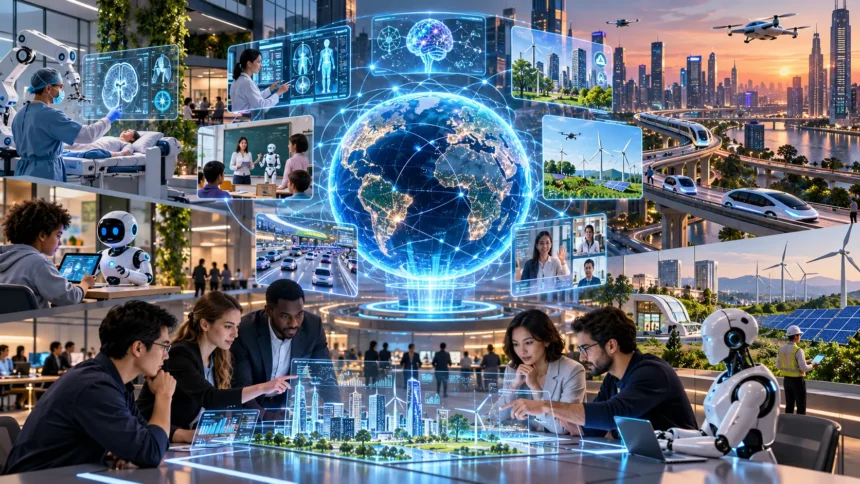
Artificial intelligence is transforming the modern world in ways that were difficult to imagine just a few decades ago. From smartphones and online shopping to healthcare and transportation, AI technologies are becoming part of everyday activities. These intelligent systems can analyze information, recognize patterns, automate tasks, and help people make decisions more efficiently.
Understanding how artificial intelligence is changing the world helps explain why businesses, governments, and individuals are increasingly interested in this technology. AI is improving certain services, supporting scientific research, and creating new opportunities for innovation. However, its rapid development also raises important questions about privacy, employment, accuracy, and responsible technology use.
Artificial intelligence is no longer limited to research laboratories or large technology companies. Schools, hospitals, manufacturers, and small businesses are exploring ways to use intelligent software. This guide explains how AI works, its influence on major industries, the benefits and challenges of adoption, and what these developments could mean for the future.
What Is Artificial Intelligence and How Does It Work?
Artificial intelligence refers to computer systems designed to perform tasks associated with human intelligence. These tasks include understanding language, identifying objects in images, recognizing patterns, and generating information. AI systems use mathematical models and computing technology to process data and produce predictions, recommendations, or responses.
Machine learning is an important part of artificial intelligence because it allows computer models to learn patterns from training data. Deep learning uses neural networks with multiple layers to process complicated information. These technologies support applications such as speech recognition, image analysis, automated translation, and personalized recommendations.
Generative AI is another important development that allows computers to create text, images, music, and software code. However, AI systems do not automatically understand the world the way humans do. Their results depend on training methods, available information, system design, and appropriate human evaluation.
How Artificial Intelligence Is Changing Everyday Life
Artificial intelligence influences many everyday activities, even when people do not realize they are using it. Smartphones, navigation applications, search engines, and streaming platforms incorporate AI-powered features. These systems help organize information, recognize user preferences, and provide convenient digital experiences.
For example, navigation applications may analyze traffic information to estimate travel times and suggest alternative routes. Streaming services use recommendation systems to suggest movies, songs, or television programs based on user activity. Smartphones also use intelligent processing to improve photography, recognize speech, and provide accessibility features.
AI-powered virtual assistants can help people organize schedules, answer questions, and complete selected digital tasks. However, their capabilities depend on the applications and services they can access. As these technologies improve, everyday devices may become more responsive while continuing to require responsible privacy and security protections.
How AI Is Transforming Healthcare
Healthcare is one of the most promising areas for artificial intelligence because medical professionals work with large amounts of complicated information. AI systems can assist with medical image analysis, clinical documentation, and certain diagnostic processes. These technologies may help healthcare workers identify patterns that require further professional investigation.
Researchers are also exploring AI applications for discovering medicines, understanding diseases, and analyzing medical research. Intelligent models can examine large datasets and help identify potential relationships that deserve additional scientific study. These capabilities may support research efficiency, although promising discoveries still require careful testing and validation.
Despite these opportunities, AI cannot replace qualified healthcare professionals or the need for individualized medical judgment. Inaccurate predictions, biased datasets, and sensitive patient information create important challenges. Responsible healthcare AI requires strong privacy protections, appropriate regulation, clinical evaluation, and human oversight.
How Artificial Intelligence Is Changing Education
Artificial intelligence is creating new opportunities for teaching and learning through adaptive educational software and digital assistance. Some learning platforms can analyze student responses and provide exercises suited to particular skill levels. These features may help learners practice difficult concepts and identify areas requiring additional attention.
AI tools can also support teachers with lesson planning, educational materials, and administrative tasks. Students may use conversational systems to explore explanations, practice languages, or brainstorm project ideas. However, AI-generated answers can contain errors, making verification and independent thinking important parts of responsible educational use.
Schools face additional challenges involving academic honesty, data privacy, and equal access to technology. AI should support learning rather than replace the effort needed to develop understanding. Teachers, parents, and students can benefit from clear guidance about appropriate uses and the limitations of automated educational tools.
How AI Is Revolutionizing Business Operations
Businesses are adopting artificial intelligence to improve efficiency, analyze information, and automate certain routine activities. AI-powered software can help organize documents, classify customer requests, and identify patterns in business data. These applications may reduce repetitive work and allow employees to focus on tasks requiring judgment and creativity.
Customer service is another area experiencing significant changes through automated support systems. AI chatbots can answer common questions, provide product information, and guide customers through basic processes. More complicated situations still benefit from human support, particularly when requests involve sensitive information or unusual circumstances.
Companies also use machine learning for demand forecasting, inventory planning, and operational analysis. However, successful implementation requires reliable data, suitable technology infrastructure, and clear business objectives. Organizations should evaluate actual improvements rather than assuming every process becomes more effective when AI is introduced.
The Impact of AI on Jobs and Employment
Artificial intelligence is changing the skills and responsibilities required in many occupations. Software developers, customer service representatives, designers, and office professionals increasingly encounter AI-assisted tools. These technologies can automate portions of certain tasks while creating opportunities for new types of work.
Some jobs may change substantially as organizations introduce intelligent automation into existing workflows. Routine tasks involving information processing, document preparation, or basic analysis may become easier to automate. However, employment effects vary between industries, and not every task within an occupation can be replaced by software.
AI is also increasing interest in skills such as machine learning, data engineering, cybersecurity, and AI system evaluation. Communication, creativity, critical thinking, and professional judgment remain valuable across many careers. Workers and educational institutions may need to adapt training programs as technology continues evolving.
How Artificial Intelligence Is Improving Transportation
Transportation systems increasingly use AI to analyze traffic conditions, improve logistics, and support vehicle technologies. Intelligent applications can process information from sensors, cameras, and navigation systems. These capabilities help organizations understand transportation patterns and make selected operational decisions more efficiently.
Autonomous vehicle research is one of the most visible examples of AI development in transportation. Self-driving systems combine sensors, machine learning, and specialized software to interpret surrounding environments. However, autonomous driving capabilities vary widely, and safe operation depends on technical limitations, environmental conditions, and applicable regulations.
AI also supports public transportation planning and commercial logistics. Delivery companies may use predictive systems to estimate travel times or organize routes. These applications can improve efficiency, but transportation technology must continue prioritizing safety, reliability, and human accountability.
How AI Is Transforming Agriculture and Food Production
Agriculture is becoming more technology-driven as farmers explore intelligent systems for monitoring crops and managing resources. AI applications can analyze weather information, soil conditions, and images collected from agricultural equipment. These insights may help farmers identify issues and make more informed decisions.
Computer vision technology can assist with detecting signs of crop disease or monitoring plant development. Precision agriculture systems may also help determine where water, fertilizers, or other resources are needed. Their effectiveness depends on reliable data, suitable equipment, and the specific agricultural environment.
Artificial intelligence may support food security by improving agricultural planning and reducing certain inefficiencies. However, smaller farms can face challenges involving technology costs, connectivity, and access to training. Practical solutions need to account for local conditions rather than assuming advanced systems are suitable for every farm.
How Artificial Intelligence Is Changing the Environment
Artificial intelligence can help researchers monitor environmental changes and analyze complicated climate information. Machine learning systems are used in areas such as weather forecasting, wildlife monitoring, and energy management. These applications can identify patterns that support scientific understanding and environmental planning.
AI may also help electricity systems forecast demand and integrate renewable energy sources more effectively. Environmental researchers can use image analysis to study land-use changes or track selected ecosystems. However, the accuracy of these applications depends on data quality and careful scientific validation.
AI itself also has environmental costs because training and operating large models can require substantial electricity, cooling, and computing equipment. The overall impact depends on infrastructure, energy sources, and application benefits. Responsible development involves improving efficiency while considering resource consumption and environmental consequences.
How AI Is Changing Entertainment and Creativity
Artificial intelligence is influencing entertainment through personalized recommendations, digital production tools, and new creative applications. Streaming platforms use algorithms to suggest content based on viewing or listening patterns. These systems help audiences discover entertainment within increasingly large collections of digital media.
Generative AI can assist with brainstorming, visual design, audio production, and other creative workflows. Writers, filmmakers, musicians, and designers may use these tools to explore ideas or complete certain technical tasks. Human creativity and editorial judgment remain important for producing meaningful and original work.
AI-generated media also raises questions about copyright, consent, authenticity, and compensation for creative professionals. Synthetic images and videos can sometimes make it difficult to distinguish real material from fabricated content. Transparent labeling and responsible production practices can help audiences understand how digital entertainment is created.
How AI Is Improving Scientific Research
Scientific research often involves analyzing enormous amounts of information, making it an important area for artificial intelligence applications. Machine learning can help researchers identify patterns in experimental data and develop predictions for further investigation. These capabilities are useful across fields such as biology, chemistry, physics, and astronomy.
AI has contributed to advances in protein structure prediction and computational research. Scientists can use specialized models to examine biological relationships and explore possible directions for experiments. However, computer predictions still require appropriate scientific verification before they can support dependable conclusions.
Artificial intelligence may also help researchers organize published studies, analyze images, and automate selected laboratory workflows. These benefits can reduce time spent on repetitive activities and support new discoveries. Nevertheless, scientific progress continues to depend on careful experimentation, transparent methods, and independent evaluation.
How AI Is Changing Cybersecurity and Online Safety
Cybersecurity professionals use AI-powered systems to examine large amounts of digital activity and identify unusual patterns. Machine learning can help classify suspicious messages, prioritize alerts, and analyze potential security incidents. These capabilities support teams responsible for protecting networks, applications, and sensitive information.
AI-based fraud detection can also identify unusual transaction behavior that may require further investigation. Financial institutions and digital platforms use automated systems to evaluate patterns and flag potentially suspicious activity. However, such systems can make mistakes, meaning important decisions may require additional review.
Artificial intelligence also introduces security challenges because deceptive content and certain cyber threats can become more sophisticated. Organizations must protect AI applications against unauthorized access, information exposure, and unreliable automated actions. Effective cybersecurity depends on combining technical safeguards with human expertise and clear security policies.
The Benefits of Artificial Intelligence for Society
One important benefit of artificial intelligence is its ability to process complicated information efficiently. AI systems can assist with tasks that would otherwise require extensive manual analysis. When properly designed, these applications may save time and support better access to useful information.
AI can also improve accessibility through speech recognition, automated captions, translation, and other assistive technologies. These tools may help people communicate, learn, and interact with digital services more independently. Their usefulness depends on accuracy, language support, inclusive design, and affordability.
Another benefit involves supporting innovation across healthcare, agriculture, education, and scientific research. AI can help professionals explore new approaches to longstanding challenges. However, positive outcomes are not automatic and require responsible implementation, reliable evaluation, and attention to the needs of affected communities.
Challenges and Risks of Artificial Intelligence
Artificial intelligence presents challenges involving privacy, fairness, reliability, and accountability. AI applications often process substantial amounts of information, sometimes including personal or confidential data. Organizations must use appropriate security measures and explain how information is collected, stored, and processed.
Bias is another important concern because AI models can reproduce patterns found within their training data. Inaccurate or unrepresentative information may lead to unfair predictions or misleading recommendations. Responsible development includes testing systems across relevant situations and providing ways to challenge consequential automated decisions.
Generative AI may also produce convincing but incorrect content, while synthetic media can contribute to misinformation. These risks make critical thinking and verification increasingly important. Developers, regulators, businesses, and users all have responsibilities in supporting safer and more trustworthy technology.
What Is the Future of Artificial Intelligence?
The future of artificial intelligence will likely involve wider integration into software, workplaces, and consumer technology. Developers are exploring AI agents capable of planning and completing connected tasks through authorized tools. These systems could support more complicated workflows while requiring careful monitoring and clearly defined permissions.
Smaller and more efficient AI models may also expand the use of intelligent features on smartphones, laptops, and other devices. Processing certain information locally could improve responsiveness and reduce dependence on remote servers. Continued progress in hardware and software efficiency may create additional opportunities for accessible AI applications.
However, predicting the exact future of AI remains difficult because technological progress depends on research, investment, regulations, and public trust. Some applications will become widely useful, while others may fail to meet expectations. The most successful developments will likely combine practical benefits with reliability, transparency, and responsible human oversight.
Conclusion
Artificial intelligence is changing the world by influencing how people work, learn, communicate, and interact with technology. Its applications extend across healthcare, education, business, agriculture, transportation, and scientific research. These developments demonstrate how intelligent systems can support useful services and create opportunities for innovation.
The benefits of AI include efficient information processing, intelligent automation, improved accessibility, and assistance with complicated tasks. However, privacy concerns, biased predictions, unreliable information, and employment changes require careful attention. Responsible implementation is essential for ensuring that technological progress supports broader social well-being.
Understanding how artificial intelligence is changing the world can help individuals and organizations prepare for future developments. Learning how AI works, recognizing its limitations, and developing relevant skills are valuable steps toward adapting. With thoughtful governance and meaningful human oversight, artificial intelligence can support positive changes across many areas of society.
Frequently Asked Questions (FAQs)
How is artificial intelligence changing the world today?
Artificial intelligence is changing healthcare, education, transportation, business, and everyday technology. It helps analyze information, automate certain tasks, improve digital services, and support scientific research across different industries.
What are five benefits of artificial intelligence?
Five important benefits include faster information analysis, improved automation, personalized services, accessibility support, and assistance with scientific research. Actual benefits depend on system reliability, appropriate implementation, and human oversight.
How does artificial intelligence affect everyday life?
AI influences navigation applications, smartphones, search engines, streaming recommendations, and digital assistants. These technologies help people organize information, communicate, discover content, and complete selected everyday tasks more conveniently.
Will artificial intelligence replace human jobs?
AI may automate portions of some jobs and change the skills required in different occupations. However, employment impacts vary, and many responsibilities continue to depend on human judgment, communication, creativity, and accountability.
What will artificial intelligence look like in the future?
Future AI systems may become more integrated into workplaces, consumer devices, and business applications. Advances in efficiency and automation could expand their usefulness, although safety, reliability, and responsible governance will remain important.