

Ask any interior designer what their biggest headache is when styling a modern living room, and the answer is almost always the same: The TV.
We spend months curating the perfect aesthetic. We select a low-profile linen sofa, we hunt for vintage mid-century coffee tables, and we layer textures to create a sense of “Japandi” calm or industrial chic. And then? We are forced to ruin it all by bolting a massive, 75-inch black rectangle onto the focal wall.
It is a “design crime” we have accepted out of necessity. When the TV is on, it’s entertainment. But when it’s off—which is most of the day—it is a void. It sucks the light out of the room, demands all the attention, and dictates that every piece of furniture must point towards it.
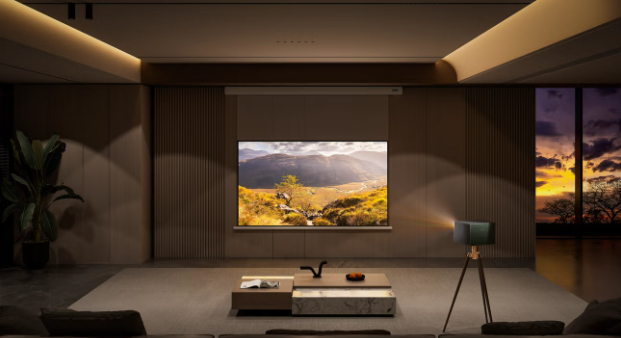
But in 2026, the paradigm is shifting. We are seeing a movement away from the “Black Box” and towards what I like to call the Invisible Cinema. By swapping the physical panel for advanced projection technology, we are finally reclaiming our walls.
Here is how to design a media room that prioritizes style first and technology second.
The Psychology of the “Off” Screen
There is a subtle psychological shift that happens when you remove a television from a room. Without that dark anchor on the wall, the space immediately feels airier and taller. The “shrine” aspect of the living room disappears. It becomes a place for conversation, reading, and connection, rather than just a place to consume content.
For minimalists, this is the holy grail.
The goal of the Invisible Cinema is to have technology that serves you when you need it and vanishes when you don’t. This is where modern projection shines. Unlike a TV, which is a permanent piece of furniture, a projected image is ephemeral. It exists only when you press play.
Reclaiming Floor Space: The Ceiling Mount Strategy
One of the biggest advantages of ditching the TV is that you can also ditch the heavy, clutter-filled media console.
In a traditional setup, the console is often just a graveyard for dusty cables and routers, sitting there solely to visually anchor the TV above it. By switching to projection, you can eliminate this bulky furniture entirely, or replace it with a sleek, floating shelf or a low bench that displays art books rather than electronics.
The key to achieving this ultra-clean look is getting the hardware off the floor. Installing a premium ceiling projector allows you to keep your sightlines completely open.
Modern ceiling mounts are no longer the industrial eyesores of the past. Many new units feature matte finishes and architectural lines that blend seamlessly with track lighting or ceiling beams. With a single cable runner (or a pre-wired ceiling drop), the technology hovers overhead, out of sight and out of mind, casting a 100-inch image over your favorite art piece or a blank, white gallery wall.
To Screen or Not to Screen?
A common question in design forums is: “Do I need a retractable screen, or can I project on the wall?”
From a purist’s perspective, a dedicated ALR (Ambient Light Rejecting) screen offers the best contrast. However, from a design perspective, projecting directly onto a wall is the ultimate minimalist move.
If you have a smooth, white or light grey wall, utilizing special projection paint can turn the architecture itself into the screen. This allows you to maintain a “gallery wall” aesthetic. You can have floating shelves or small framed art on the sides, and when movie night starts, the image simply fills the negative space between them.
If you prefer a screen, the trend is now “hidden integration.” We are seeing motorized screens recessed into ceiling bulkheads or hidden behind crown molding. You press a button, and the cinema drops down from the architecture itself. It’s very James Bond, and very effective at maintaining visual purity.
Lighting: Creating the “Lounge” Vibe
The harsh blue light of a TV often fights with the warm, ambient lighting of a well-designed room. Projectors, however, use reflected light. This is softer on the eyes and blends more naturally with warm-dimming LED bulbs and floor lamps.
When designing your Invisible Cinema, think about “layers” of light.
- Bias Lighting: Soft LED strips behind the screen area to reduce eye strain.
- Task Lighting: A reading lamp by the armchair that doesn’t cast glare on the wall.
- Dimmers: Absolute control is essential.
Because modern laser projectors are significantly brighter than their predecessors, you no longer need a “bat cave.” You can keep a warm, cozy vibe with low-level lighting while watching a film, maintaining that “lounge” atmosphere rather than a sterile theater feel.
Choosing Hardware as Decor
If you cannot ceiling mount and must place the device on a coffee table or shelf, the hardware’s aesthetics become critical.
For years, tech companies designed projectors that looked like office equipment—white plastic blobs with vents. Thankfully, that era is over. The new wave of high-end home cinema gear utilizes materials like brushed aluminum, glass, and fabric meshes. They look closer to high-end audio equipment or architectural models than office supplies.
When you are shopping for the best 4k projector to fit a designed space, treat it like you would a lamp or a vase. Look at the silhouette. Does the finish match your hardware accents (brass, matte black, chrome)? Does it look good from the back (since it might be sitting in the middle of the room)?
Conclusion: Design Freedom
The beauty of the Invisible Cinema is that it gives you back your freedom. You are no longer beholden to the “TV Wall.” You can orient your sofa to face the window or the fireplace. You can hang a large abstract painting where the screen “should” be.
And then, when the sun goes down and the wine is poured, you can summon a 120-inch theater out of thin air. It is the best of both worlds: high design by day, high immersion by night.