
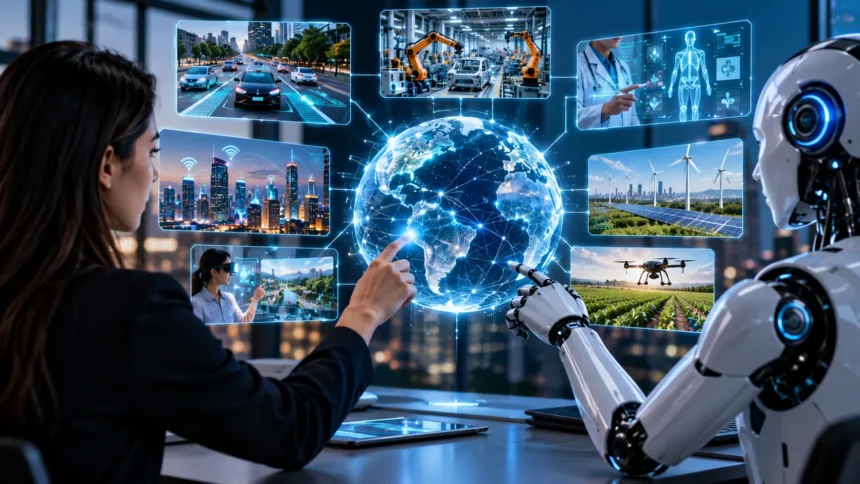
Machine learning is transforming the future of technology by changing how computers process information, solve problems, and support human decisions. From intelligent healthcare systems to automated business operations, machine learning allows organizations to identify patterns and develop technologies that respond to changing information. Its growing applications are influencing industries, workplaces, and everyday digital experiences.
As artificial intelligence continues to evolve, machine learning plays an important role in developing smarter software, improving automation, and supporting technological innovation. However, its impact depends on data quality, responsible development, and practical implementation. Understanding how machine learning is transforming technology helps explain its opportunities, challenges, and potential influence on the digital world.
What Is Machine Learning and Why Does It Matter?
Machine learning is a branch of artificial intelligence that enables computer systems to identify patterns and make predictions using data. Unlike traditional programs that depend entirely on predefined instructions, machine learning models develop statistical relationships through training. These models can process unfamiliar information and generate useful results. This makes machine learning valuable for problems involving complex or changing datasets.
The importance of machine learning comes from its ability to analyze information at a scale that would be difficult for humans to manage manually. Businesses can examine customer activity, scientists can study complex datasets, and engineers can monitor equipment performance. These applications help identify trends and support better decisions. However, predictions still require evaluation because models can produce incorrect results.
Machine learning also supports the development of technologies that adapt to new information. Recommendation engines, speech recognition systems, and predictive maintenance tools demonstrate this capability. Their performance can improve when models are updated using suitable data and evaluation methods. As digital information grows, machine learning is becoming an important component of modern technological systems.
How Machine Learning Is Changing Modern Technology
Machine learning is changing modern technology by introducing data-driven prediction and automated analysis into software applications. Developers can create systems that recognize images, understand speech patterns, and classify large collections of information. These capabilities expand what traditional software can accomplish. They also make certain digital services more responsive to user behavior and changing conditions.
One major transformation involves the growing connection between machine learning and existing technologies. Cloud computing, mobile applications, connected devices, and business platforms increasingly incorporate trained models. These integrations allow organizations to analyze information within familiar digital workflows. However, successful implementation requires reliable data systems, appropriate infrastructure, and careful performance monitoring.
Machine learning is also influencing how technology products are designed and maintained. Developers may use predictive models to identify software problems, analyze user activity, and improve service delivery. Automated tools can support routine tasks while people focus on complex decisions. This shift creates opportunities for efficiency, although human oversight remains important.
The Role of Machine Learning in Artificial Intelligence
Machine learning is a major approach used to develop modern artificial intelligence systems. It provides methods for training computers to identify relationships within text, images, audio, and other information. Deep learning, a specialized form of machine learning, supports many advanced AI applications. Together, these technologies have expanded the capabilities of intelligent software.
Generative artificial intelligence is one area strongly influenced by machine learning research. Large language models and image generation systems use neural networks trained on extensive datasets. They can produce text, images, and other outputs based on learned statistical patterns. However, generated information can contain inaccuracies, making verification important in sensitive applications.
Machine learning does not represent every form of artificial intelligence. Some AI systems use explicit rules, search methods, or other computational approaches. Modern applications may combine these techniques with trained models to achieve specific objectives. Understanding this distinction helps explain machine learning’s importance without assuming that all intelligent technologies operate identically.
Machine Learning and the Future of Automation
Automation has traditionally relied on predefined rules to complete repetitive tasks. Machine learning expands these capabilities by helping systems interpret information and respond to situations that are difficult to describe through fixed instructions. This can improve document processing, quality inspection, and operational monitoring. Organizations increasingly explore these applications to reduce manual effort.
In manufacturing environments, machine learning models can examine sensor readings and identify patterns associated with equipment problems. Automated systems may then alert maintenance teams before certain failures occur. Similar approaches support inventory forecasting and production planning. These tools help organizations make better use of available resources when predictions are sufficiently reliable.
The future of automation is likely to involve greater collaboration between humans and intelligent software. Automated systems can handle selected routine activities while employees manage exceptions and make important judgments. However, implementation may also change job responsibilities and skill requirements. Training and appropriate safeguards are necessary to ensure that automation delivers practical benefits.
How Machine Learning Is Transforming Healthcare
Healthcare is an important area where machine learning supports research, medical analysis, and selected clinical workflows. Some systems help trained professionals examine medical images and identify patterns that may require attention. Others analyze administrative information to improve scheduling and resource planning. These applications demonstrate how predictive technologies can assist healthcare organizations.
Machine learning also contributes to medical research by helping scientists analyze complex biological information. Researchers may use models to investigate relationships within genetic data, disease patterns, and potential drug candidates. Such analysis can help prioritize areas for further study. However, computer predictions require scientific testing and clinical validation before they can support medical decisions.
Patient safety remains essential as machine learning becomes more common in healthcare technology. Models trained on incomplete or unrepresentative datasets may produce unreliable outcomes for certain populations. Privacy, explainability, and professional oversight must also be considered. Machine learning should support qualified healthcare professionals rather than replace appropriate medical evaluation and judgment.
Machine Learning in Education and Personalized Learning
Machine learning is influencing educational technology by supporting personalized recommendations and automated learning tools. Some platforms analyze student performance to identify topics that may require additional practice. They can suggest exercises or lessons based on previous responses. This approach may help educators provide learning materials suited to different educational needs.
Language learning applications offer practical examples of machine learning in education. Speech recognition technology can evaluate spoken language and provide feedback on pronunciation. Other systems recommend vocabulary exercises or review activities according to learner progress. However, automated feedback may be imperfect and should complement meaningful instruction.
Educational organizations also use data analysis to understand learning patterns and improve administrative processes. Predictive models may help identify students who could benefit from additional academic support. Such systems require careful evaluation to avoid unfair assumptions about individual abilities. Protecting student privacy and maintaining teacher involvement are essential parts of responsible implementation.
How Machine Learning Is Changing Business Operations
Businesses increasingly use machine learning to support forecasting, operational planning, and customer analysis. Predictive models can examine historical sales data to estimate future demand. Organizations may use these estimates to guide purchasing and inventory decisions. However, changing economic conditions can reduce prediction accuracy, making regular evaluation necessary.
Machine learning can also improve the organization and processing of business information. Automated classification tools help categorize documents, customer requests, and financial records. This reduces some repetitive administrative tasks and allows employees to focus on activities requiring human judgment. The effectiveness of these systems depends on appropriate training data and integration with existing workflows.
Another important application involves identifying patterns that suggest operational problems or emerging opportunities. Businesses may analyze delivery performance, equipment activity, or customer feedback to recognize useful trends. These insights can support more informed decisions across departments. Machine learning works best when predictions are combined with practical business knowledge.
The Impact of Machine Learning on Digital Marketing
Machine learning has become an important component of digital marketing technology. Advertising platforms use predictive systems to support audience targeting, campaign optimization, and advertisement delivery. Businesses may also analyze customer interactions to estimate conversion likelihood. These applications help marketers understand patterns within large volumes of campaign data.
Recommendation systems provide another example of machine learning in marketing. Online stores can suggest products based on browsing activity, purchase history, and similarities between customer interests. Content platforms may recommend articles or videos using comparable methods. These features can improve relevance, although recommendations are not guaranteed to match individual preferences.
Search technology also incorporates machine learning for tasks such as understanding queries and evaluating relevance. For SEO professionals, this reinforces the importance of helpful content, clear website structure, and satisfying search intent. Machine learning does not eliminate traditional search optimization principles. Instead, it contributes to evolving systems that interpret information and user needs.
Machine Learning in Cybersecurity
Cybersecurity systems use machine learning to help identify unusual activity and patterns associated with potential threats. Models can examine network traffic, login behavior, and system events to highlight suspicious changes. These tools may help security teams prioritize investigations. However, an unusual pattern does not always indicate malicious activity.
Machine learning can support spam detection, phishing identification, and certain forms of malware analysis. Classification models examine features that may distinguish suspicious content from legitimate activity. Their effectiveness depends on representative training data and regular updates. Cybercriminal techniques also evolve, which can reduce the reliability of outdated models.
Despite these benefits, machine learning cannot provide complete cybersecurity protection on its own. Models may generate false alarms or fail to recognize unfamiliar threats. Attackers may also attempt to manipulate automated detection systems. Strong cybersecurity requires multiple protective measures, trained professionals, and continuous monitoring alongside machine learning tools.
How Machine Learning Is Improving Financial Technology
Financial institutions use machine learning to analyze transaction patterns, evaluate operational risks, and support fraud detection. Predictive models can identify unusual activity that may require additional investigation. These systems help organizations process large transaction volumes efficiently. However, suspicious activity alerts must be handled carefully to avoid unnecessary disruption.
Machine learning also supports financial forecasting and selected customer service applications. Banks may use automated systems to categorize inquiries or analyze historical financial information. Investment research platforms sometimes use models to study market patterns. Nevertheless, financial markets are unpredictable, and machine learning cannot guarantee accurate forecasts or investment returns.
Fairness and transparency are particularly important when automated models influence financial decisions. Inaccurate or biased training data can contribute to unfair outcomes. Organizations must consider applicable regulations, privacy requirements, and suitable review procedures. Human oversight remains important when decisions may significantly affect customers and their financial opportunities.
Machine Learning and the Internet of Things
The Internet of Things connects physical devices that collect and exchange information through digital networks. Examples include smart home sensors, industrial monitoring equipment, and connected agricultural devices. Machine learning helps analyze the data these systems generate. This combination allows certain devices and platforms to detect patterns and respond to changing conditions.
Smart building technologies demonstrate how machine learning can support connected systems. Sensors collect information about temperature, occupancy, and energy consumption. Predictive models may help adjust heating, cooling, or lighting according to observed patterns. These applications can support efficiency, although actual savings depend on system design and operating conditions.
Industrial IoT systems also use machine learning for equipment monitoring and maintenance planning. Models can examine sensor information to identify changes that may indicate developing problems. Early warnings may help reduce unexpected downtime when predictions are accurate. Reliable connectivity, secure data handling, and suitable maintenance processes remain essential for successful deployment.
Machine Learning in Transportation and Smart Cities
Transportation technology uses machine learning to analyze traffic patterns, estimate travel conditions, and support route planning. Navigation platforms may combine historical information with current traffic observations to estimate journey times. These predictions can help people make informed travel decisions. However, unexpected incidents and changing conditions can still affect accuracy.
Machine learning is also used in research and development involving advanced driver-assistance and autonomous vehicle technologies. Computer vision models can help identify road markings, vehicles, and other objects. Additional systems support prediction and decision-making processes. Because transportation safety is critical, these technologies require extensive testing and appropriate human or system oversight.
Smart city initiatives may use machine learning to study energy consumption, infrastructure conditions, and public transportation demand. Predictive analysis can support planning and resource allocation across urban services. However, collecting large amounts of information introduces privacy and governance concerns. Responsible projects must balance efficiency with transparency and public interests.
Machine Learning and the Future of Robotics
Robotics combines mechanical engineering, electronics, computer science, and control systems to create machines capable of performing physical tasks. Machine learning can improve certain robotic capabilities by helping systems interpret sensor information and recognize patterns. These techniques are useful for object identification and selected movement tasks. They complement traditional programming and control methods.
Manufacturing robots may use computer vision models to inspect products or identify objects during automated processes. Warehouse systems can also incorporate machine learning for sorting, navigation, and operational planning. Such applications may improve efficiency when environments are suitable for automation. However, physical reliability and workplace safety remain essential design requirements.
Researchers are exploring how reinforcement learning and other approaches can improve robotic adaptability. These methods allow simulated or controlled systems to develop strategies through feedback. Transferring learned behavior into unpredictable real-world environments remains challenging. The future of intelligent robotics will likely depend on combining machine learning with dependable engineering and safety systems.
How Machine Learning Supports Cloud Computing
Cloud computing provides computing resources, storage, and software services through network-connected infrastructure. Machine learning applications often depend on these resources because training and operating models can require substantial processing power. Cloud platforms allow organizations to access scalable infrastructure without purchasing every component themselves. This can simplify experimentation and deployment for suitable projects.
Many cloud services provide tools for preparing data, training models, and managing machine learning applications. Developers can use these platforms to organize datasets and evaluate predictive systems. Managed services may reduce certain infrastructure responsibilities. However, users still need to consider data security, operating costs, and the reliability of their applications.
Machine learning can also support the management of cloud environments. Predictive analysis may help estimate resource demand, identify unusual activity, or improve workload scheduling. These capabilities can contribute to more efficient operations when properly configured. As cloud technologies evolve, machine learning will remain an important tool for building and operating intelligent applications.
Benefits of Machine Learning for Future Technologies
One of the main benefits of machine learning is its ability to process complex information and identify useful statistical patterns. This supports applications that require prediction, classification, and automated analysis. Organizations can use these capabilities to improve selected workflows and explore new services. The practical value depends on accuracy and the quality of available data.
Machine learning can also make digital experiences more responsive to individual needs. Recommendation systems, accessibility tools, and language technologies provide examples of personalized applications. These systems may improve convenience by adapting outputs to relevant information. However, personalization should be balanced with privacy protection and user control.
Another benefit involves supporting scientific and technological research. Machine learning helps researchers examine large datasets, compare complex patterns, and prioritize experiments. These tools may accelerate selected stages of discovery without replacing scientific verification. Their greatest value often comes from combining computational analysis with human expertise and sound research methods.
Challenges Facing Machine Learning Technology
Despite its advantages, machine learning faces significant challenges involving data quality and reliability. A model trained on inaccurate or biased information may produce misleading predictions. Performance can also decline when real-world conditions differ from the training environment. Continuous evaluation helps identify these problems before they create serious consequences.
Privacy and security are additional concerns as organizations collect and process large datasets. Sensitive information must be protected throughout model development and deployment. Some machine learning systems can also expose information or become vulnerable to manipulation if poorly designed. Responsible data governance and appropriate security measures are essential.
Computational costs and environmental considerations also influence the future of machine learning. Training large models may require substantial electricity, specialized hardware, and financial investment. Smaller organizations can face barriers when developing advanced systems. Research into more efficient algorithms and infrastructure may help make machine learning more accessible.
Future Trends in Machine Learning
One important machine learning trend involves developing systems that can work with multiple forms of information. Multimodal models can process combinations of text, images, audio, and other data types. These capabilities may support more flexible digital assistants and analytical applications. Their reliability will depend on careful evaluation across different tasks.
Another developing area is edge machine learning, which allows selected models to operate closer to where data is collected. Smartphones, sensors, and connected devices can perform certain predictions without continuously sending information to distant servers. This approach may reduce latency and support some privacy goals. However, device limitations and secure implementation remain important considerations.
Researchers are also working on efficient models, improved interpretability, and techniques that require less manually labeled data. These developments could make machine learning more practical across diverse industries. Responsible artificial intelligence practices are likely to remain central to adoption. Future progress will depend on balancing technological capability with safety, transparency, and measurable benefits.
How to Prepare for a Machine Learning-Driven Future
Preparing for a machine learning-driven future begins with understanding basic digital and data literacy concepts. Students and professionals can learn how algorithms identify patterns and why predictions are sometimes inaccurate. Knowledge of statistics and critical thinking helps people evaluate automated results. These skills are useful even without becoming a machine learning engineer.
People interested in technical careers may benefit from learning Python, data analysis, and fundamental machine learning algorithms. Practical projects can help connect theoretical concepts with real-world applications. Understanding model evaluation is particularly important because high training accuracy does not guarantee reliable performance. Gradual learning builds a stronger foundation than focusing exclusively on advanced tools.
Organizations can prepare by identifying practical problems where data-driven analysis may provide measurable value. They should evaluate data availability, implementation costs, and potential risks before adopting new systems. Employee training and human oversight can improve the quality of deployment. Successful machine learning adoption depends on clear objectives rather than technology trends alone.
Conclusion
Machine learning is transforming the future of technology by expanding the capabilities of artificial intelligence, automation, and data-driven applications. Its influence can be seen in healthcare, education, cybersecurity, finance, transportation, and business operations. These technologies help systems analyze information and support decisions that would otherwise require extensive manual processing.
As machine learning develops, new opportunities are emerging through cloud computing, connected devices, robotics, and multimodal artificial intelligence. However, improved capabilities do not eliminate challenges involving accuracy, privacy, fairness, and computational costs. Responsible development and effective human oversight remain necessary for reliable implementation. Organizations must evaluate practical outcomes rather than relying on ambitious predictions.
The future of machine learning will depend on continued research, appropriate governance, and the ability to solve meaningful problems. Students, professionals, and businesses can benefit from understanding its basic principles and limitations. By combining machine learning with human expertise, technology developers can create systems that are more useful, efficient, and responsive to real-world needs.
Frequently Asked Questions
How is machine learning transforming the future of technology?
Machine learning is transforming technology by enabling systems to analyze data, recognize patterns, and support automated decisions. It contributes to advances in artificial intelligence, healthcare, cybersecurity, robotics, and business applications.
What industries will benefit most from machine learning?
Healthcare, finance, manufacturing, education, transportation, and digital technology are among the industries using machine learning. Its benefits depend on available data, application requirements, and responsible implementation.
Will machine learning replace human jobs?
Machine learning may automate certain tasks and change job responsibilities, but it does not mean every occupation will disappear. Human judgment, creativity, communication, and oversight remain important across many industries.
What is the future of machine learning in artificial intelligence?
Machine learning research is advancing multimodal models, efficient algorithms, and intelligent applications. Future progress may improve automation and data analysis, although reliability, privacy, and responsible development remain essential challenges.
Why is machine learning important for students?
Machine learning helps students understand modern artificial intelligence, data analysis, and technological problem-solving. Learning its basic principles can support future studies and careers in software development, research, engineering, and other fields.